
From Visible to Near-Infrared — An Application Map for Wavelength Selection
When selecting a semiconductor laser, wavelength is often the first parameter engineers consider. However, facing the wide range from 405 nm to 2000 nm, how to make the optimal choice?
This involves not only technical specifications but also the fundamental principles of light-matter interaction, atmospheric transmission, fiber loss characteristics, eye safety regulations, and ultimately the application requirements.
This article systematically reviews the physical properties, main application scenarios, and key selection points for wavelengths from visible to near-infrared, helping engineers build a clear wavelength selection logic.
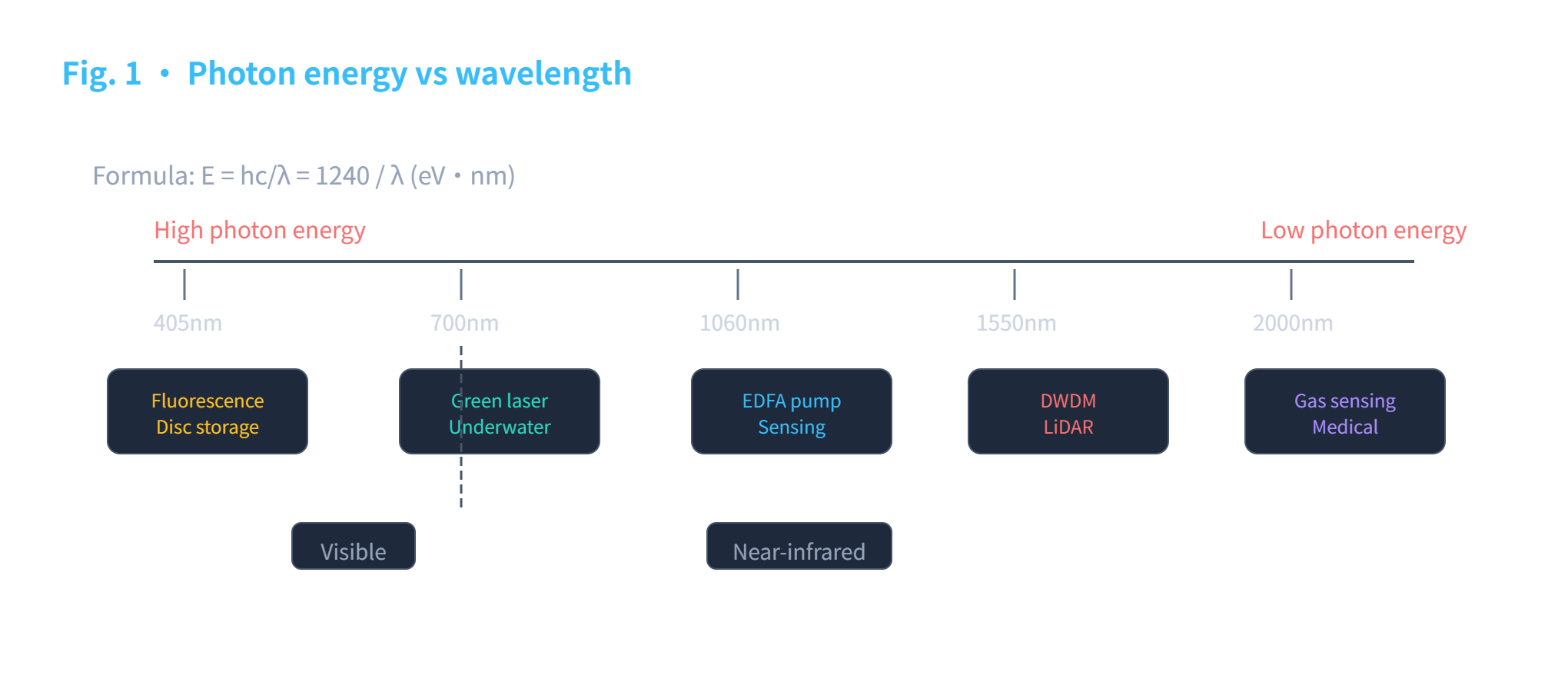
Shorter wavelength → higher photon energy; visible for fluorescence/indication, IR for communication/sensing
1. Wavelength and Photon Energy: The Basic Selection Logic
Photon energy E = hc/λ = 1240/λ (eV·nm). Shorter wavelengths have higher photon energy. Short wavelengths (visible 400-700nm) are suitable for fluorescence excitation, photochemical reactions, displays and bioimaging; long wavelengths (NIR 700-2000nm) have low photon energy, less damage, and are ideal for communication, sensing and eye-safe applications. Also consider atmospheric windows, fiber loss, detector response and eye safety.
2. Visible Band (405-700nm): High Photon Energy Applications
2.1 Blue band (405-488nm)
405nm excites many fluorescent dyes (fluorescence microscopy); 445-460nm high-power blue lasers are used in laser displays and material processing (plastic welding). Blue lasers require strict eye protection.
2.2 Green to red band (520-700nm)
Green (532nm) is most sensitive to the human eye (1mW green appears as bright as several mW of blue/red), widely used in laser pointers, leveling instruments, underwater communication (lowest absorption in seawater). Red lasers (650-670nm) are mature and low-cost, used in pointers, alignment, lab experiments.
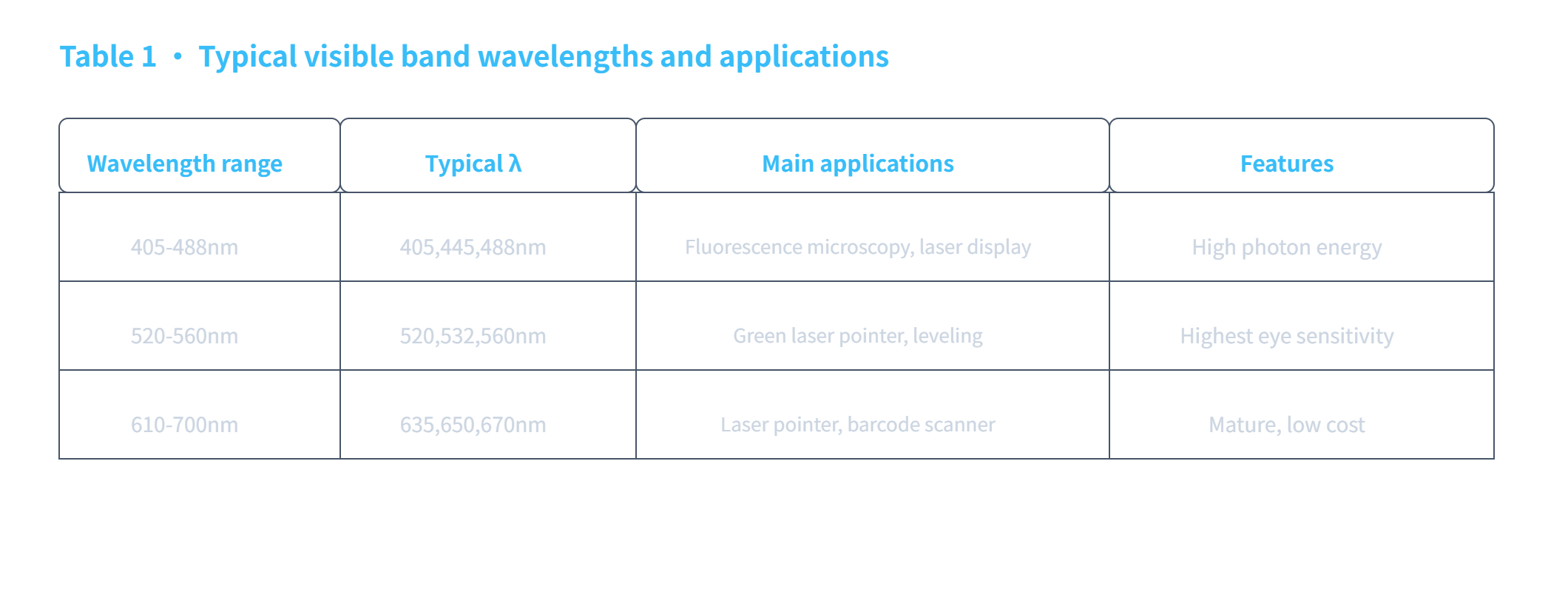
Table 1 · Visible band typical wavelengths and applications
3. Near-Infrared Short Wave Band (700-1060nm): Bridge between Technology and Applications
3.1 850nm & 880nm: Short-reach communication window
850nm is at the peak of Si detector responsivity (0.6-0.8 A/W), VCSELs are mature, used in data center interconnects (10G-100G) with OM3/OM4 multimode fiber. 880nm is better for optical sensing, reduces visible light interference.
3.2 980nm: Classic pumping and sensing wavelength
980nm is the standard pump wavelength for EDFA (high pumping efficiency). Also used for near-infrared fluorescence excitation, laser surgery assistance, night vision illumination.
3.3 1060nm band: Complementary for single-mode communication
1060nm lies in the low-dispersion region of silica fiber, used for short-reach single-mode transmission, interferometric sensors, laser ranging, and dental lasers.
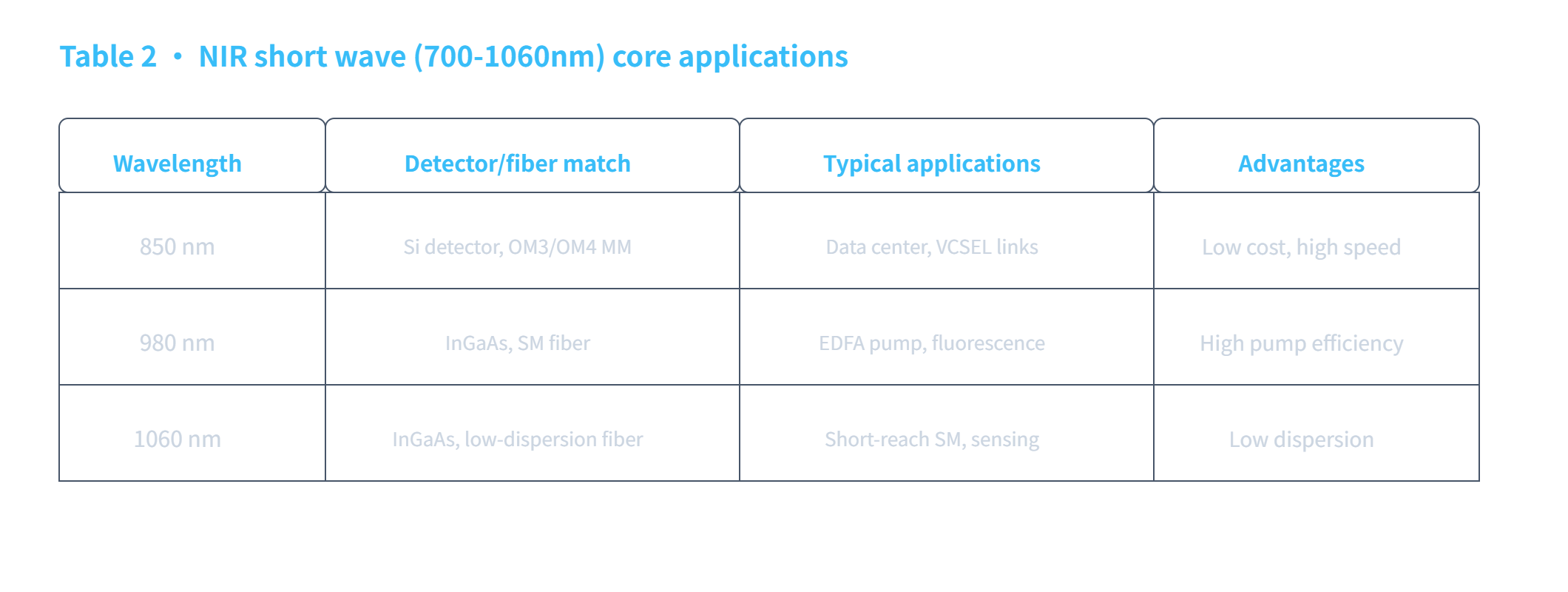
Table 2 · NIR short wave (700-1060nm) core applications and technology matching
4. Near-Infrared Long Wave Band (1080-1550nm): Core Window for Fiber Communication
4.1 1310nm: Zero-dispersion window
Standard single-mode fiber G.652 has near-zero dispersion at 1310nm, minimizing signal distortion. Used for data center interconnects (hundreds of meters), metro networks (10G/25G), 5G front-haul, and fiber sensing.
4.2 1550nm: Lowest loss window
Silica fiber has lowest loss at 1550nm (0.2 dB/km) and falls in the EDFA gain band, enabling ultra-long haul transmission and DWDM. Also eye-safe power limit is ~100× higher than visible light, widely used in LiDAR, laser ranging and Brillouin sensing.
4.3 1310nm vs 1550nm: How to choose
Choose 1310nm for transmission distance
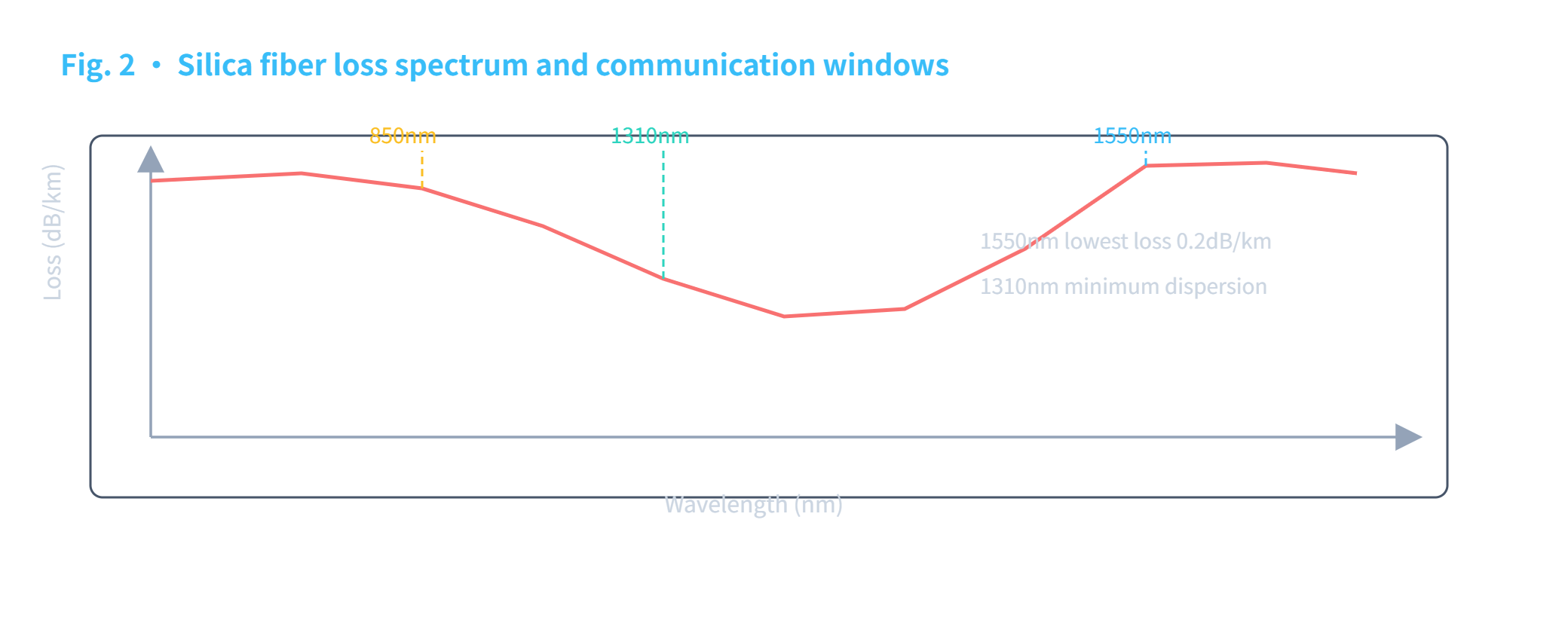
Silica fiber has three main communication windows: 850nm (multimode), 1310nm (zero dispersion), 1550nm (lowest loss)
5. Long-Wavelength Band (1550-2000nm): Emerging Applications and Extended Window
5.1 1600nm band: New window for SWIR imaging
Short-wave infrared (SWIR, 900-1700nm) imaging: many materials opaque in visible (plastics, paper) become transparent; strong atmospheric penetration, used for semiconductor inspection (silicon transparency), food sorting, security surveillance.
5.2 2000nm band: New frontier for high-power lasers
Water absorption peak at 1940nm, 2000nm lasers enable precise soft-tissue cutting and coagulation; gas detection (methane absorption line), Tm fiber laser pumping, space communication. Long-wavelength InGaAsP efficiency is lower, requires careful thermal management and InGaAs detectors.
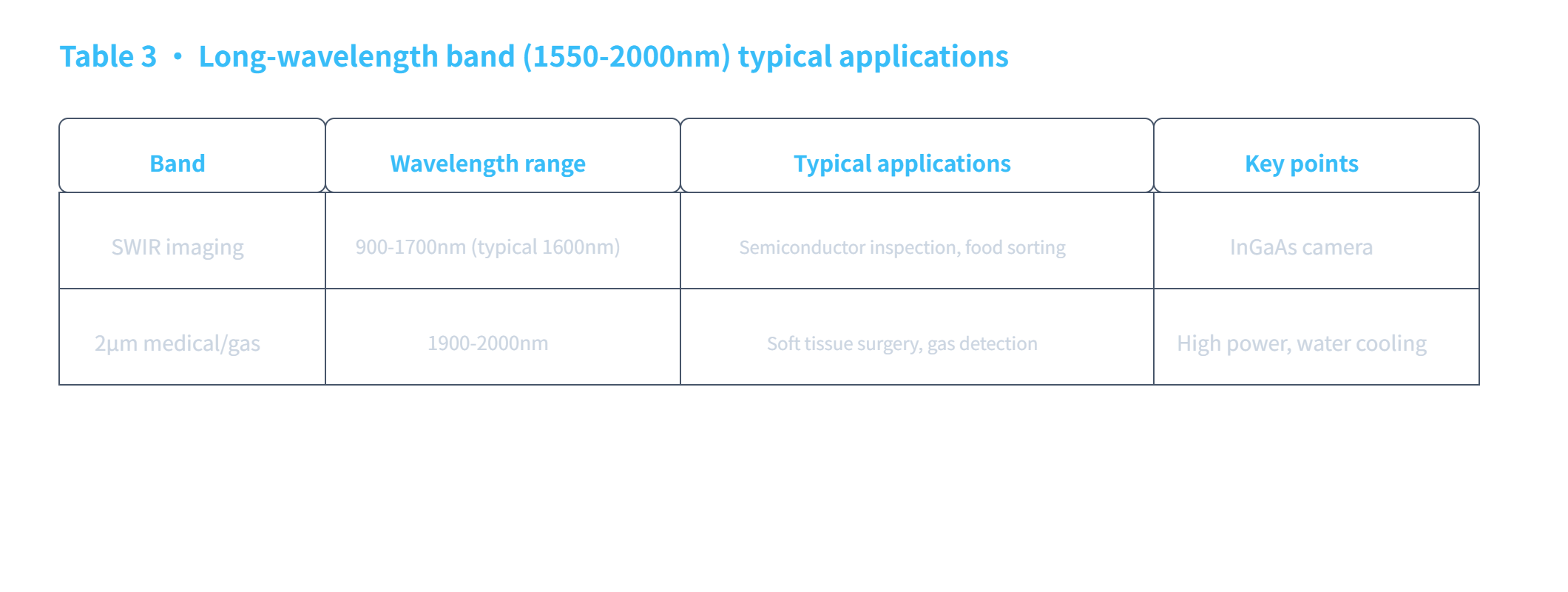
Long-wavelength extension to 2000nm supports SWIR imaging, medical surgery and special sensing
6. Systematic Wavelength Selection Method
Selection should follow a logic from application to device parameters:
① Determine transmission distance, medium, environment;
② Based on distance/eye safety/absorption peak, select candidate wavelengths;
③ Evaluate availability of supporting components (detectors, fiber, passive devices).
Also balance power and efficiency: short-wavelength devices offer higher output power (tens of mW to watts), long-wavelength (>1550nm) FP lasers typically 10-20 mW;
linewidth and coherence: FP lasers have nm-scale linewidth, narrow linewidth requires DFB/DBR;
temperature coefficient: wavelength drift 0.3-0.5 nm/°C, thermal control may be necessary.
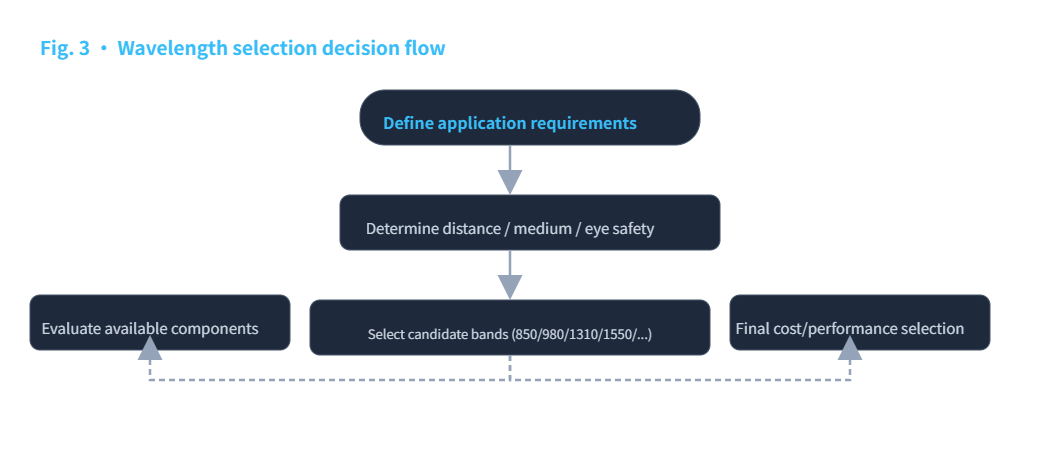
From application → candidate bands → supporting components → total cost, forming a complete selection loop
7. Auxiliary Selection Factors: Eye Safety, Detector Matching and Cost Trade-offs
Beyond the application, wavelength selection is also constrained by eye safety limits (IEC 60825-1), detector response characteristics, and component cost. The table below summarizes maximum permissible exposure (MPE), recommended detectors, and relative cost trends for each band.
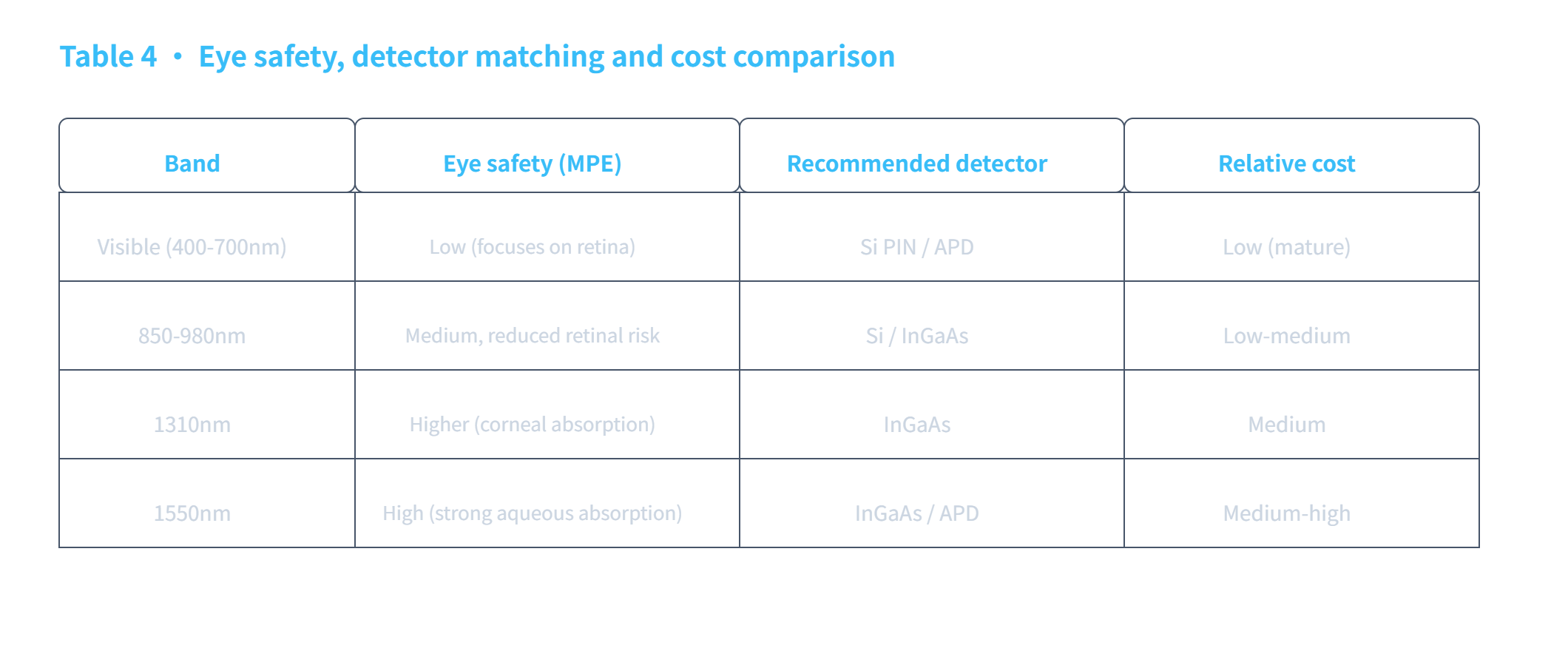
Longer wavelength gives higher eye-safety limit; 1550nm preferred for long-range LiDAR, visible requires strict protection
8. Band Quick Reference Table
For quick reference, the following table summarizes typical applications, fiber types, packages and technology maturity for each band.
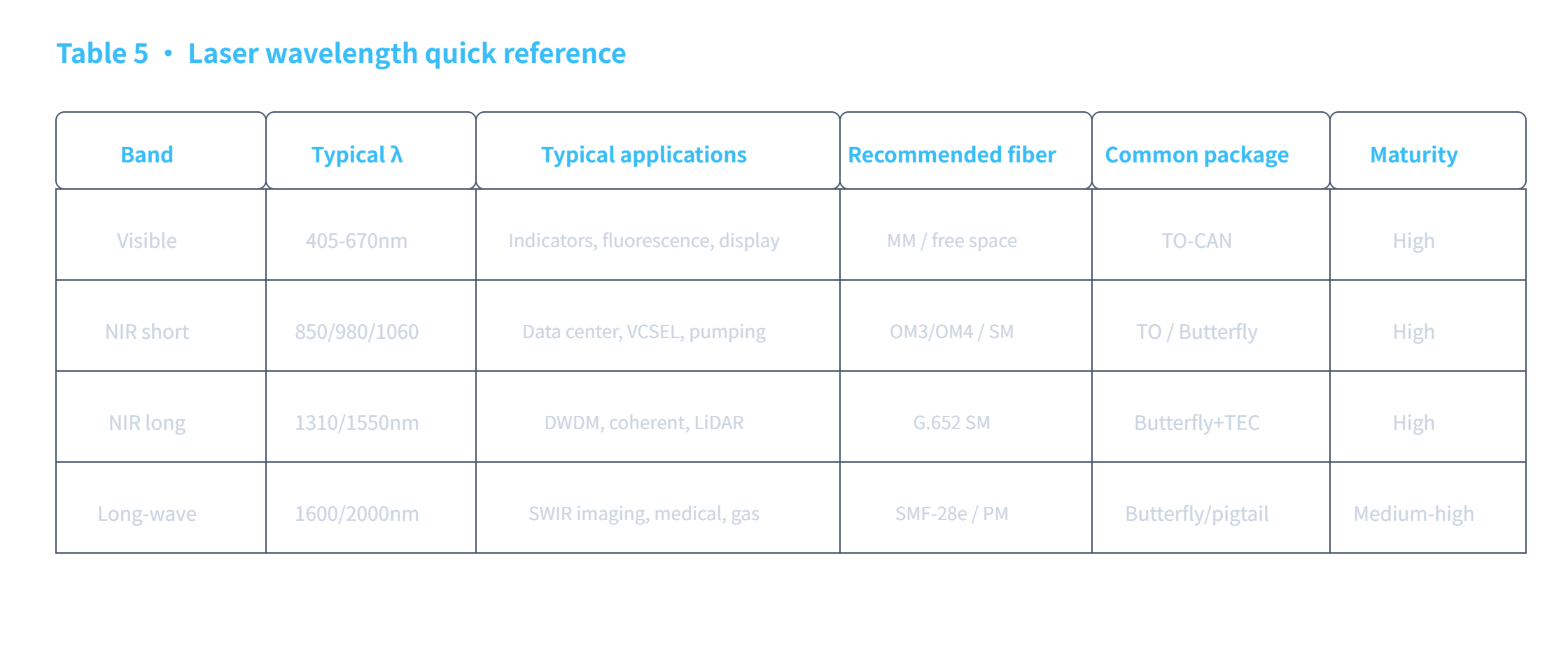
Table 5 · Laser wavelength quick reference covering visible to long-wave bands, fiber and package recommendations
9. Summary
Semiconductor laser wavelength selection involves multiple factors: optical physics, atmospheric transmission, fiber loss, eye safety, and cost. There is no "best" wavelength, only the one "most suitable" for the application. The key is to start from the application requirements rather than from device parameters, understand the underlying physics, and make a balanced trade-off. With continuous advances in quantum dot lasers and silicon photonics, the boundaries of wavelength selection are expanding.