
Optical Frequency Comb (OFC) is hailed as the “optical ruler” and one of the most revolutionary precision measurement tools of the 21st century. In 2005, John L. Hall and Theodor W. Hänsch were awarded the Nobel Prize in Physics for their pioneering contributions to precision laser spectroscopy and optical frequency comb technology. Instead of a single frequency, a comb outputs a series of equally spaced, coherent, ultra-narrow linewidth laser lines that span a broad spectral range. Each “tooth” can be precisely referenced to an optical standard, making it a ruler for measuring any unknown optical frequency. The comb simultaneously solves three measurement challenges: it provides a direct bridge from radio frequencies to optical frequencies, all teeth are mutually coherent enabling two-way conversion, and its broad spectral coverage allows wide-band precision measurements.
1. Three Technology Routes: From Lab to Chip-Scale
After more than two decades, the global comb landscape has converged on three mainstream routes: mode-locked laser combs (highest precision), electro-optic combs (programmable spacing), and microcombs (chip-integrated), along with dual-comb systems for high-speed real-time operation. The table below compares the key characteristics.
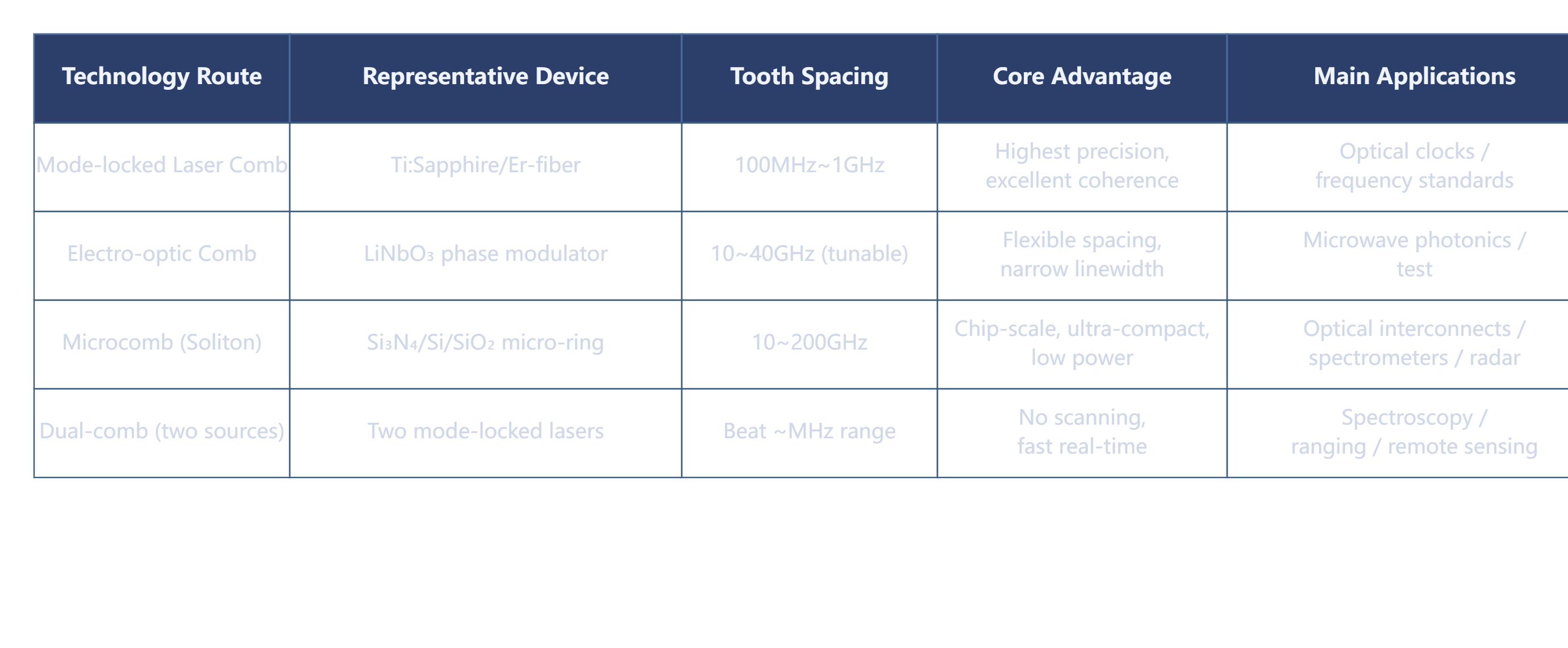
Table 1: Comparison of three main optical frequency comb technology routes
In 2026, microcombs reached a milestone: the EPFL Kippenberg group demonstrated in Nature Photonics an integrated soliton microcomb with repetition rate as low as 10 GHz on a silicon-nitride photonic chip, with ultra-low loss enabling self-starting Kerr solitons. This key step brings combs from the lab to chip-scale applications.
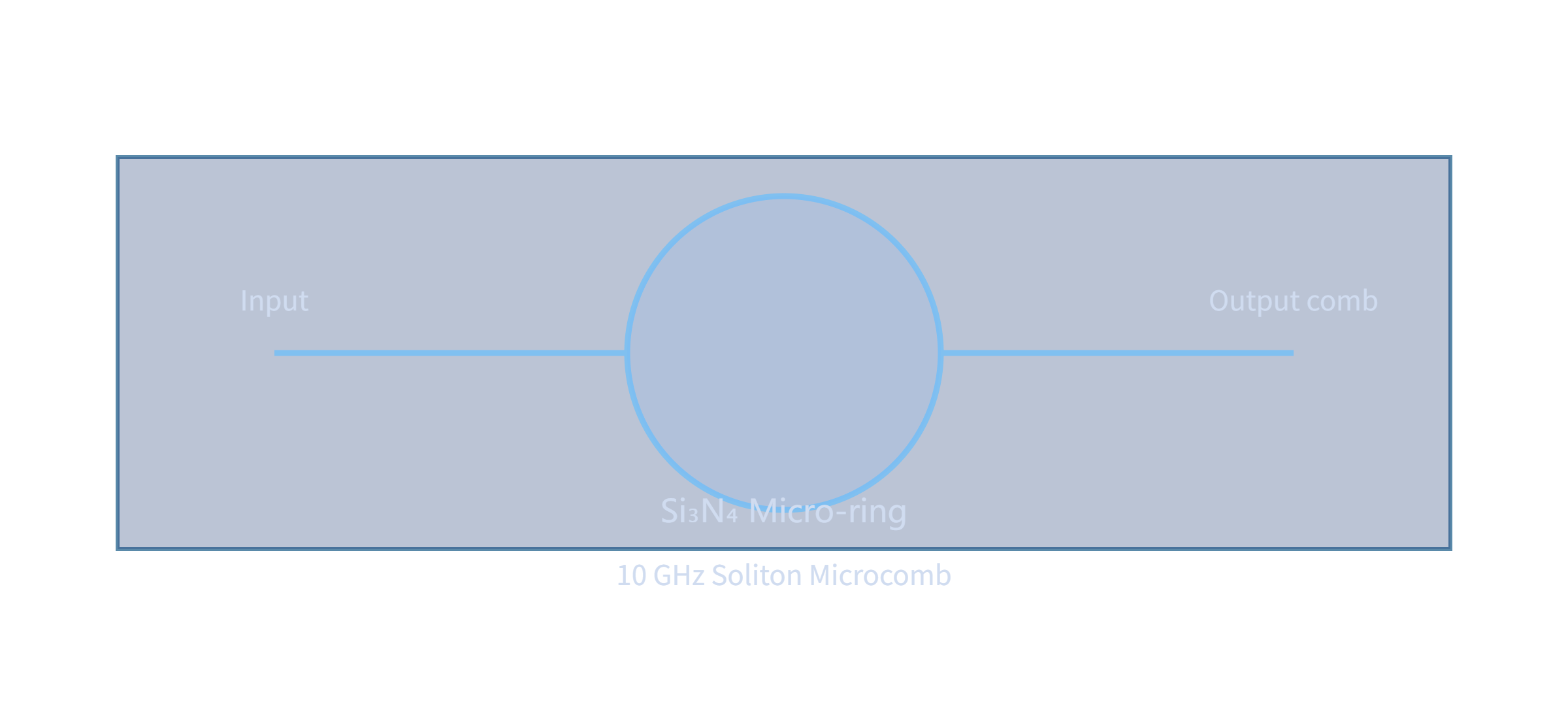
Chip-scale soliton microcomb: a silicon-nitride micro-ring generating a 10 GHz repetition-rate comb
2. 2026 Breakthroughs: Domestic Innovation and International Frontiers
2.1 Institute of Physics, CAS: Ultra-High-Q Microcavity Enables “Ideal Soliton Comb”
In 2025, the group of Li Beibei at the Institute of Physics (CAS), in collaboration with Beihang University and Peking University, published in Photonics Research a universal spectral purification technique for whispering-gallery-mode microcavities. By depositing a metal ring on the micro-disk, they selectively suppressed higher-order modes, reducing the number of modes within a 25 GHz free spectral range from >30 to 6, while maintaining a Q-factor exceeding 10⁸ for the fundamental mode. Dispersion waves were eliminated, yielding a perfect Sech² soliton spectrum. At 25 GHz carrier frequency, a microwave signal with phase noise of –125 dBc/Hz at 10 kHz offset was generated, approaching commercial microwave source performance.
2.2 Pan Jianwei Group (USTC): 100-km Dual-Comb Atmospheric Remote Sensing
In 2026, the cross-disciplinary team led by Pan Jianwei, Dou Xiankang, Zhang Qiang, and Xue Xianghui at USTC reported in Nature Photonics the first 100-km open-atmosphere dual-comb spectroscopy measurement. By combining high-power low-noise combs with time-frequency transfer techniques, they achieved real-time remote sensing of greenhouse gases (CO₂, CH₄) and pollutants (NO₂, SO₂) over a 100-km path. This breakthrough paves the way for space-based (satellite-to-ground) atmospheric monitoring.
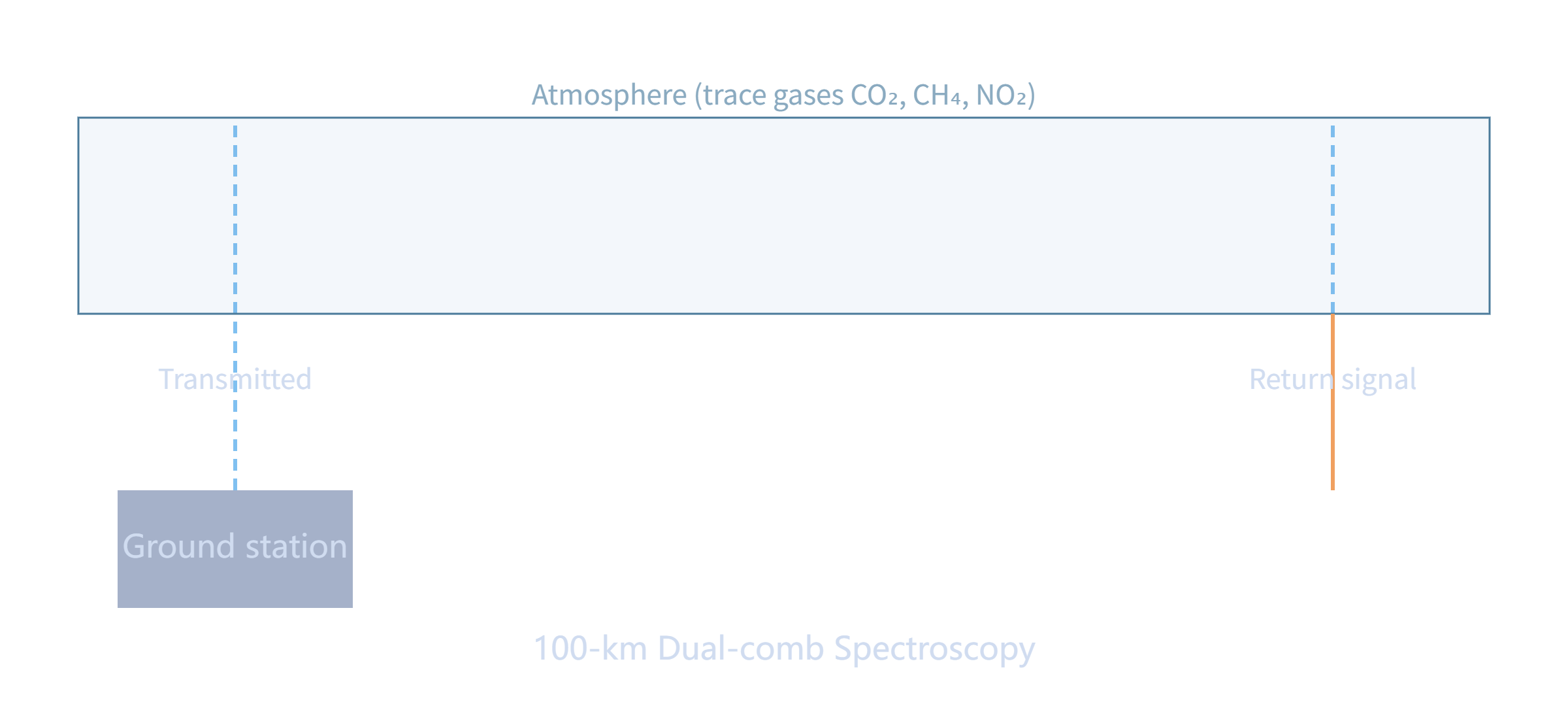
100-km dual-comb remote sensing: ground-to-atmosphere real-time spectral measurement
2.3 Shanghai Institute of Microsystem: Terahertz Dual-Comb Real-Time Detection
The group of Cao Juncheng and Li Hua at SIMIT (CAS), in collaboration with East China Normal University, demonstrated compact real-time THz dual-comb spectroscopy using electrically pumped quantum-cascade laser (QCL) combs with self-detection. This simplifies system architecture and pushes THz technology towards practical applications in material characterization and security screening.
2.4 Entangled Dual-Comb Spectroscopy: Beyond the Quantum Noise Limit
In 2025, Science reported “Entangled Dual-Comb Spectroscopy” (EDCS), introducing quantum entanglement into combs. The measurement precision surpasses the classical shot-noise limit, offering multi-fold improvement in photon-limited scenarios such as biological tissue spectroscopy and fast transient detection.
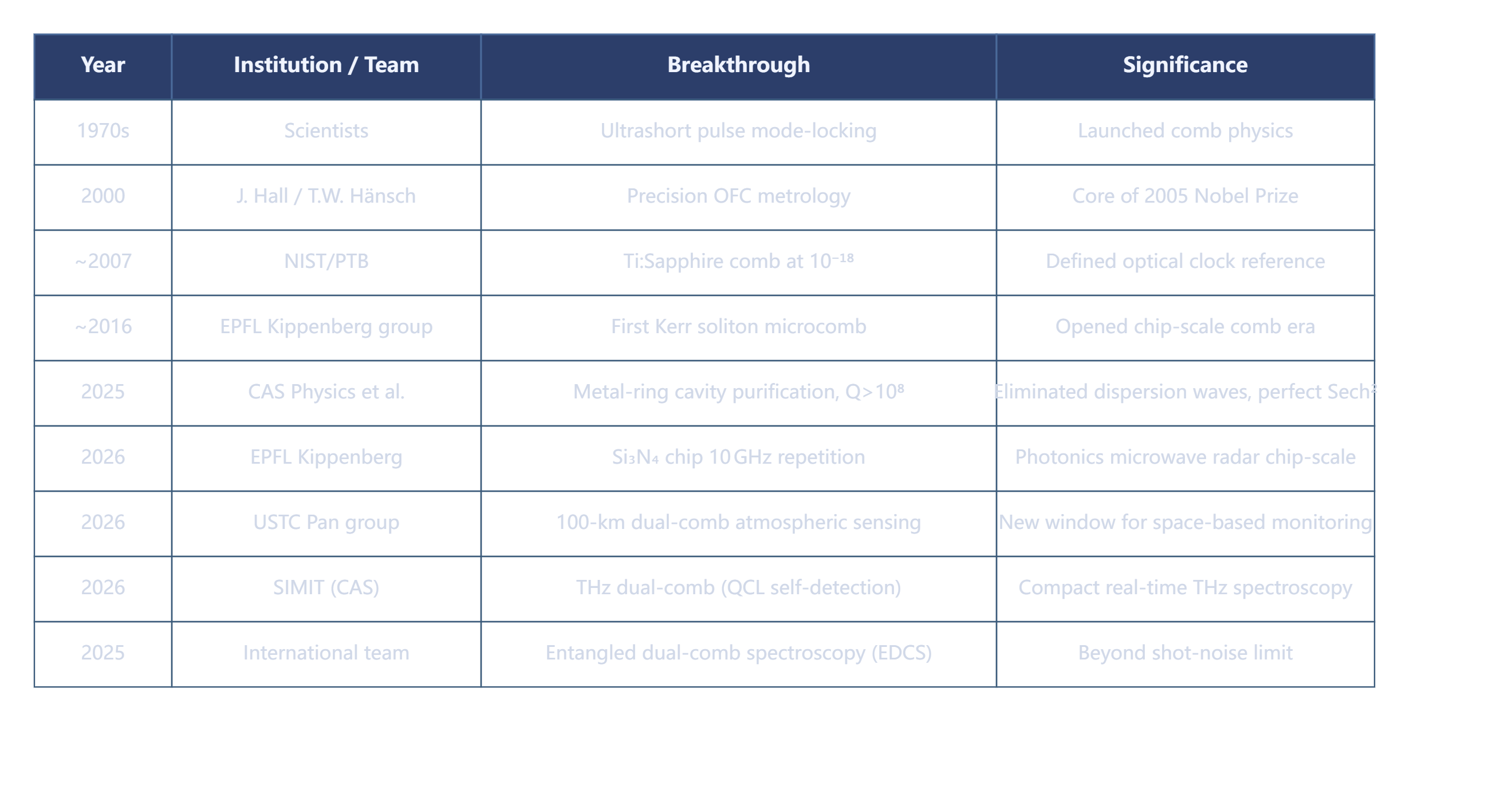
Table 2: Key milestones of optical frequency comb technology
3. Application Landscape: From Optical Atomic Clocks to Photonic Radar
3.1 Optical Atomic Clocks and Time-Frequency Transfer
Combs act as a “frequency bridge”, dividing the ultra-stable optical frequency of atomic clocks (precision 10⁻¹⁸) down to the microwave domain for electronics. Squeezed dual-comb spectroscopy (2025 Science) further suppresses shot noise, setting the stage for next-generation time-frequency transfer.
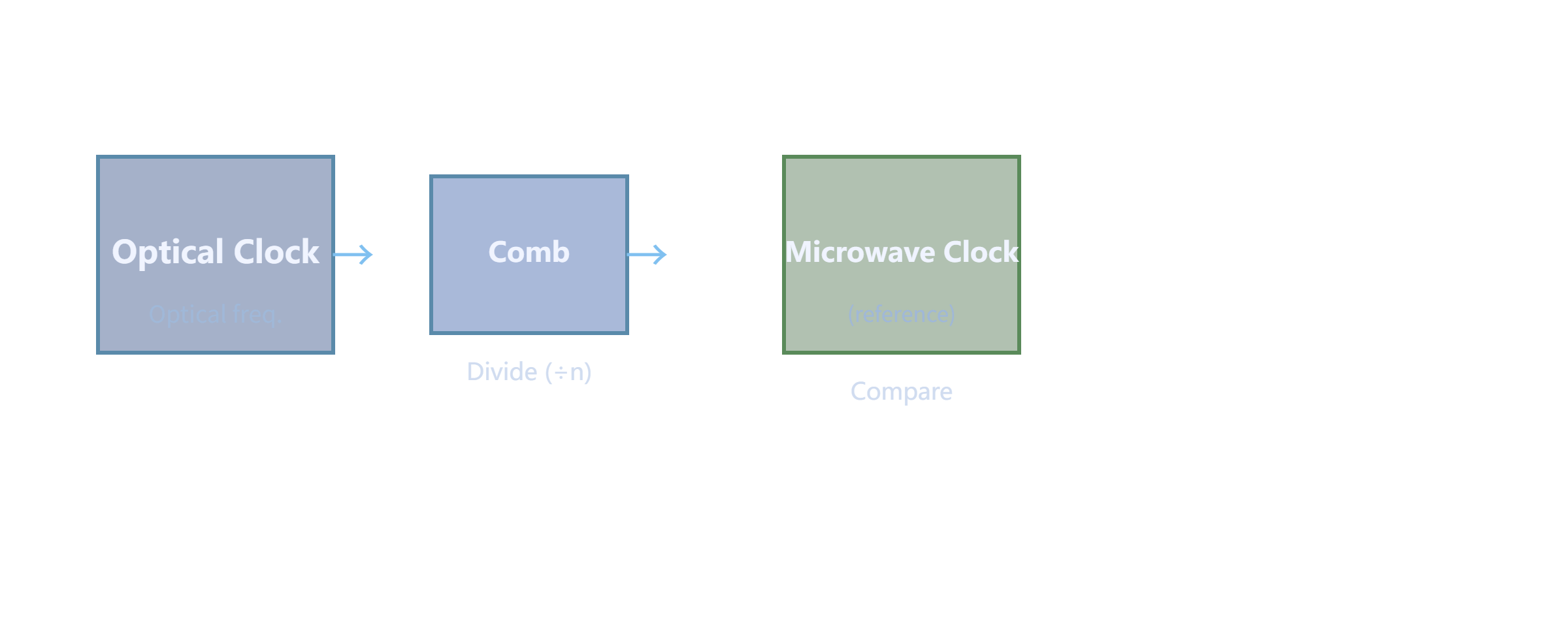
The comb down-converts the clock frequency to microwave for precision time-frequency transfer
3.2 Dual-Comb Spectroscopy: The “Universal Probe” for Industry and Research
Dual-comb spectroscopy (DCS) acquires high-resolution broadband spectra in real-time without mechanical scanning, at speeds 100–1000 times faster than traditional FTIR. It is used in semiconductor wafer inspection, combustion diagnostics, and breath analysis. Domestic programmable fiber combs have been applied to THz instrumentation, multi-photon 3D printing, and wafer dicing.
3.3 Chip-Scale Combs for 6G Communications and Photonic Radar
The 10-GHz microcomb provides low-noise local oscillators for 6G terahertz communications and photonic radar. Photonic radar generates broadband linear frequency-modulated (chirp) signals via optical techniques, achieving centimetre-level resolution. Chip-scale integration shrinks the system from benchtop to chip size, enabling airborne and spaceborne radar.
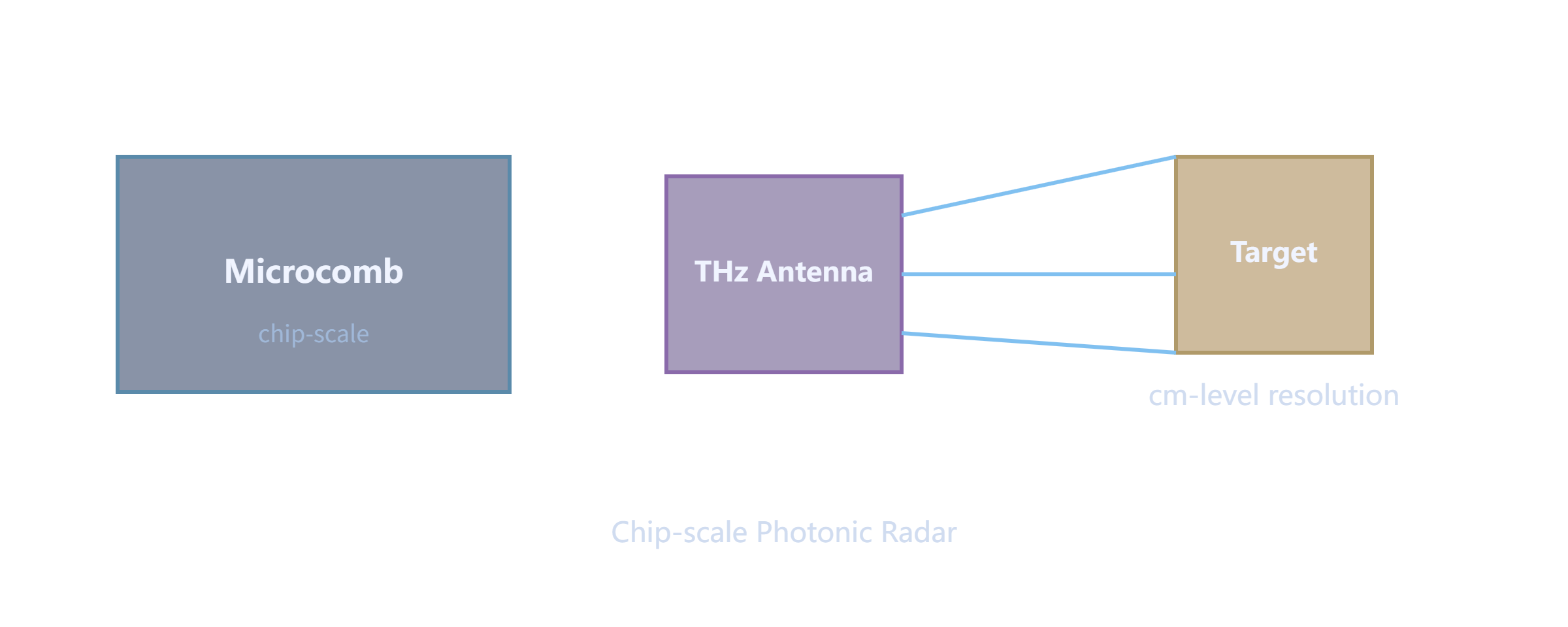
Chip-scale comb-driven photonic radar: THz local oscillator and high-resolution ranging
3.4 Astronomical Spectrograph Calibration and Precision Ranging
Combs serve as the “ultimate calibrator” for exoplanet hunting, improving spectrograph calibration precision by 1000 times, enabling detection of Earth-like planets via ~10 cm/s radial velocity signals. Ground-based GHz-class dual-comb systems achieve sub-millimetre non-contact displacement measurement.
4. Market Landscape: Domestic Players Accelerate Catch-up
According to QYResearch, the global comb laser market was approximately $57 million in 2025 and is projected to reach $99 million by 2032 (CAGR 8.2%). Western companies (K2 Photonics, Menlo Systems, Menhir Photonics, TOPTICA) lead the high-end market; domestic players such as Langyan Technology (Guangdong) offer self-referenced fiber combs with 10⁻¹⁵ stability and programmable tooth spacing, while the National Optoelectronic Innovation Center (NOEIC) is advancing quantum-dot mode-locked combs. Although gaps remain in ultra-low noise and special wavelength bands, the gap is narrowing rapidly with a maturing domestic ultrafast laser supply chain.
5. Summary and Outlook
Optical frequency combs have journeyed from Nobel-prize laboratories to industrial floors, terahertz skies, and chip-scale integration. Three future directions stand out: (1) chip-scale miniaturisation (Si₃N₄ and LiNbO₃ platforms reducing cost and size by 1–2 orders of magnitude); (2) quantum-enhanced and AI-powered combs (entanglement/squeezing + neural-network spectral analysis); and (3) space-based global monitoring – the 100-km remote sensing breakthrough makes satellite-borne combs feasible for climate science and greenhouse-gas accounting. When an optical ruler can measure atomic transitions, the boundaries of what we can measure expand beyond previous limits.
Conclusion
The optical frequency comb is a revolutionary tool for precision metrology. From the 2005 Nobel Prize to the 2026 100-km remote sensing, it continues to push the limits of our control over optical frequencies. Chip-scale integration, quantum enhancement, and space-based deployment will lead the comb into an even broader future.