
Conventional continuous-wave lasers produce pulses with widths on the millisecond to microsecond scale, while ultrafast lasers can generate pulses as short as picoseconds (10⁻¹² s), femtoseconds (10⁻¹⁵ s), and even attoseconds (10⁻¹⁸ s).
When pulse duration is compressed to the femtosecond regime, the laser energy is confined into an extremely short temporal window, causing the peak power to skyrocket – even with an average power of only a few watts, the peak power of a femtosecond laser can easily reach the GW (10⁹ W) level.
The 2023 Nobel Prize in Physics was awarded to Pierre Agostini, Ferenc Krausz, and Anne L'Huillier for their pioneering contributions to "generation of attosecond light pulses for the observation of electron dynamics."
This marks the elevation of ultrafast lasers from industrial precision tools to a core means for humanity to probe the electronic motions in the microscopic world.
I. Core Physical Effects of Ultrafast Lasers
The key to ultrafast lasers acting as "micro scalpels" lies in the unique physical effects brought by their extremely short pulses:
Cold Machining: The pulse duration is much shorter than the thermal diffusion time, so the energy is deposited before it can spread to the surrounding material, resulting in a heat-affected zone (HAZ) close to zero. This enables crack-free, invisible cutting of brittle materials such as glass, sapphire, and ceramics.
Multiphoton Absorption: Under femtosecond peak powers, materials undergo multiphoton ionization at the focal point, enabling sub-micron, true three-dimensional micro-nano processing that surpasses the optical diffraction limit.
Nonlinear Effects: Nonlinear processes such as high-order harmonic generation (HHG), optical rectification, and terahertz radiation all rely on ultrafast strong-field driving.
II. Generation and Amplification: Mode-Locking + Chirped Pulse Amplification (CPA)
The generation and amplification of ultrafast lasers depend on two core technologies: Mode-Locking and Chirped Pulse Amplification (CPA).
Mode-locking is the physical mechanism for generating ultrashort pulses. When multiple longitudinal modes in a laser cavity maintain a fixed phase relationship, their coherent superposition forms extremely short pulses – the more longitudinal modes, the shorter the pulse.
Active mode-locking uses an acousto-optic or electro-optic modulator to force synchronization of the longitudinal modes, while passive mode-locking relies on saturable absorbers (such as semiconductor saturable absorber mirrors – SESAM, or nonlinear optical loop mirrors – NALM) for self-starting operation.
However, direct amplification of high-peak-power pulses would damage the gain medium and introduce substantial self-phase modulation (SPM).
In 1974, Gerard Mourou and Donna Strickland invented CPA technology to elegantly solve this problem: the ultrashort pulse to be amplified is first "stretched" (chirped) in time by tens to thousands of times, reducing the peak power before safe amplification in the gain medium, and finally compressed back to the original pulse duration using a grating or fiber compressor.
CPA boosted laser peak power from the MW level to the PW (10¹⁵ W) level, and the two inventors jointly received the 2018 Nobel Prize in Physics for this breakthrough.
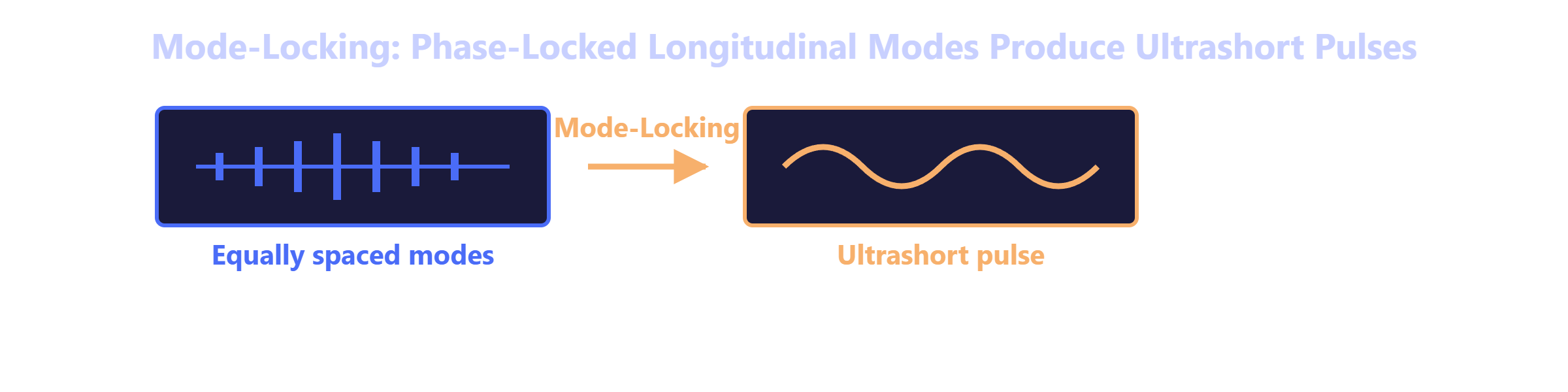
Figure 1: Mode-locking locks the phases of longitudinal modes to produce ultrashort pulses

Figure 2: Chirped Pulse Amplification (CPA) – stretch, amplify, compress
III. Technology Lineage
Ultrafast laser technology has evolved into several mature routes, each with distinct wavelengths, pulse durations, average powers, and industrial applicability.
Ti:sapphire lasers use Ti:Al₂O₃ crystals, achieving 5–100 fs pulses over 700–1100 nm, and are the workhorse for attosecond physics and high-order harmonic generation.
Yb-doped fiber lasers (Yb:fiber) employ Yb³⁺-doped fibers, delivering 100 fs–10 ps pulses at 1030 nm, making them the mainstream choice for industrial precision machining and CPA amplification.
Er-doped fiber lasers (Er:fiber) use Er³⁺-doped fibers, offering 100 fs–10 ps pulses at 1550 nm for telecommunications, dual-comb applications, and low-noise systems.
Innoslab lasers use Nd:YVO₄ slab gain media, producing pulses from ps to sub-ns at 914/1064 nm, suitable for high-power industrial and kilowatt-level synthesis.
Diode-pumped solid-state lasers (Nd:YAG) deliver ps to hundred-ps pulses at 1064/532 nm, widely applied in photovoltaics and BTBT battery processing.
Domestic players have recently made significant strides: in March 2025, AOC Photonics successfully developed a 2000 W femtosecond laser by coherently combining six 400 W lasers (Horizon-400-IR), marking a major milestone in the kilowatt-level femtosecond domain.
The Shanghai Institute of Optics and Fine Mechanics (SIOM) has also achieved a 1 MHz repetition-rate, 200 W average-power femtosecond laser source, with a peak power of 5.35 GW after 8-fold pulse compression, supporting high-brightness extreme-ultraviolet high-order harmonic generation.
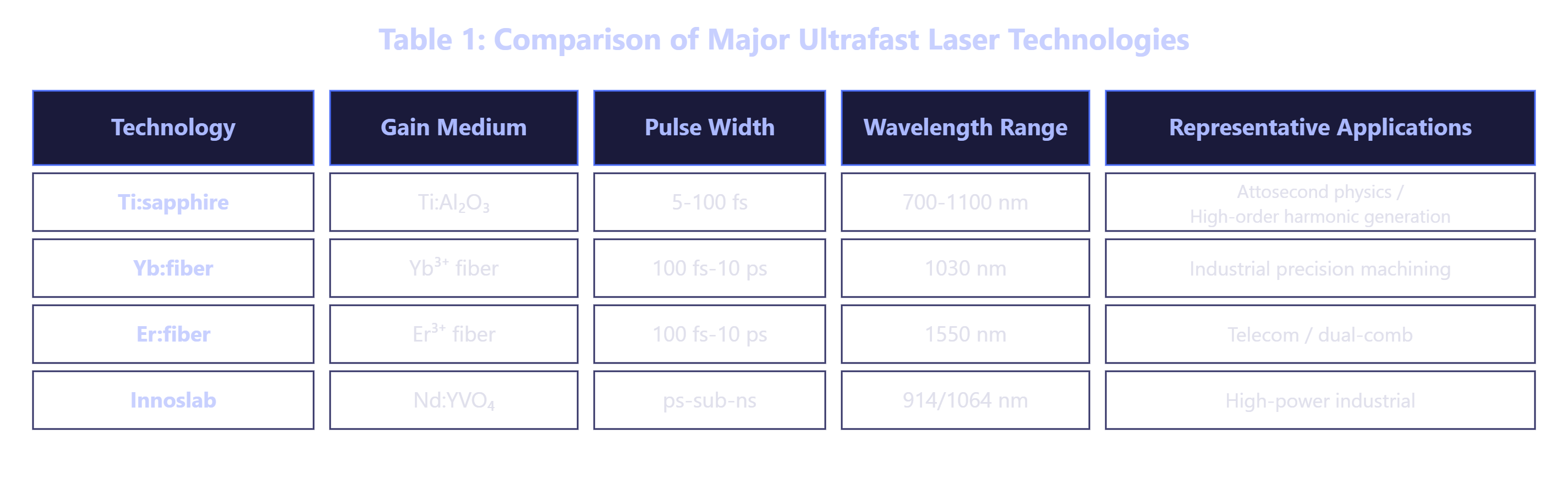
Figure 3: Comparison of major ultrafast laser technology routes
IV. Industrial Precision Machining: From Semiconductor Wafers to Photovoltaic Cells
4.1 Semiconductor & Advanced Packaging: Domestic Breakthrough in TGV Laser Drilling
In advanced packaging, Through Glass Via (TGV) technology is key for 3D heterogeneous integration, replacing Through Silicon Via (TSV) to avoid high-frequency losses in silicon.
The challenge lies in the brittleness and hardness of glass; traditional dry etching is slow and costly. Femtosecond/picosecond lasers can precisely modify regions inside the glass to achieve stress-free micro-hole drilling.
Sharp Laser's subsidiary Shanghai Guoshen Optoelectronics has achieved a mature breakthrough: their femtosecond lasers are now successfully used in TGV drilling, and picosecond lasers have been applied in mass production for silicon carbide (SiC) wafer dicing.
This means domestic ultrafast lasers are filling a critical gap in computing manufacturing, supporting AI chip packaging and localization of SiC power devices.
4.2 Photovoltaic Cells: Historic GW-Scale Mass-Production Order
In 2025, Shengxiong Laser signed a GW-scale mass-production contract with a leading photovoltaic company for BC (Back Contact) battery manufacturing, using their UV picosecond lasers – a historic order for domestic picosecond lasers in the photovoltaic industry.
BC batteries have no front-side grid shading, making them a key direction for improving conversion efficiency. Their production requires high-precision picosecond laser patterning (poly-silicon thinning, selective etching) as a substitute for some photolithography steps.
The large-scale application of domestic UV picosecond lasers is breaking the monopoly of imported equipment in high-precision photovoltaic processing.
In 2026, Hymson Laser's green picosecond laser won the Laser Gold Award – New Application Award. With self-developed optical design and sealing solutions, it has been mass-applied in photovoltaic back-side thinning processes.
Its high absorption in poly-silicon enables selective poly-silicon etching, improving conversion efficiency; in BC cell processing, it replaces some photolithography steps for micron-scale patterning, precisely controlling electrode layout and avoiding front-side shading losses, earning it the reputation of a "sharp tool" for PV efficiency improvement and cost reduction.
4.3 Brittle Materials: Femtosecond Invisible Cutting Enters the "15th Five-Year Plan" Scale-Up Cycle
The precision machining of brittle transparent materials such as sapphire substrates, glass covers, and ceramic packages is a niche where ultrafast lasers have a clear advantage. Femtosecond lasers achieve "cold cutting" inside glass – the HAZ is nearly zero, and cut surfaces are smooth and debris-free.
According to China Business Industry Research Institute, the Chinese laser market will exceed RMB 150 billion in 2026.
PwC analysis indicates that the surging demand for fine micro-nano processing in semiconductor wafers, flexible full-screen displays, and high-end biomedical interventional devices will drive picosecond and femtosecond ultrafast lasers into a cost-reduction cycle from lab to production line.
The stability of domestic ultrafast sources has made significant progress by the end of the "14th Five-Year Plan." Entering the "15th Five-Year Plan," niche segments like invisible cutting of brittle transparent materials are expected to replicate the large-scale import substitution seen with nanosecond lasers.
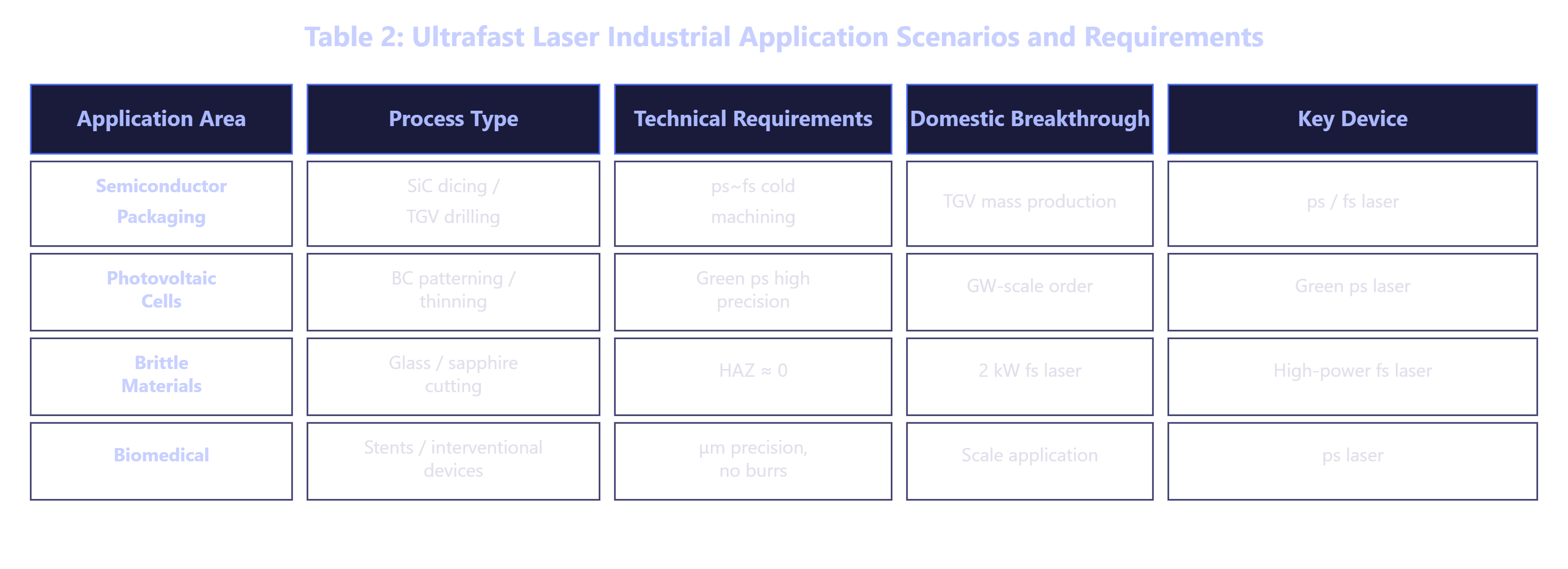
Figure 4: Ultrafast laser industrial application scenarios and technical requirements
V. Attosecond Science: The "Ultra-High-Speed Camera" for Capturing Electron Motion
5.1 High-Order Harmonic Generation and Attosecond Pulse Production
The physical source of attosecond pulses is high-order harmonic generation (HHG): when an intense femtosecond laser is focused onto a noble gas, electrons are accelerated and re-collide with the parent ion, emitting photons in the form of high-order harmonics.
Key features of HHG include: spectral coverage from extreme ultraviolet (XUV) to soft X-rays, photon energies up to hundreds of eV, extremely high coherence, and natural pulse durations in the attosecond range.
In 2001, the first experimental observation of attosecond pulse trains made direct observation of electron dynamics possible.
Today, attosecond pulses can "photograph" electrons moving inside atoms – measuring electron orbital motion, bond breaking, and formation processes. The three 2023 Nobel laureates are pioneers in this field.

Figure 5: High-order harmonic generation (HHG) producing attosecond pulses
5.2 Chinese Frontiers: Xi'an Institute of Optics and Precision Mechanics – "Attosecond Camera" Published in Nature Sub-journal
In 2026, the Attosecond Science and Technology Research Center at the Xi'an Institute of Optics and Precision Mechanics (XIOPM) achieved new progress in attosecond high-spatiotemporal-resolution imaging, published in the journal Photonics Research (IF:7.254).
The team proposed an efficient gradient monochromatization method based on Fourier-transform mode mapping, which processes polychromatic or broadband (Δλ/λc > 100%) attosecond diffraction patterns to obtain high-quality monochromatic diffractograms, then combines with coherent diffraction imaging (CDI) to achieve high-resolution imaging – essentially equipping the attosecond light source with a "high-precision lens," transforming it from a "flickering flash" into a "camera that can take pictures."
Furthermore, Professor Zhao Zengxiu's group at the National University of Defense Technology, using their self-built attosecond transient absorption spectroscopy platform, revealed that strong-field-induced coherent Raman scattering is the physical origin of the time delay in ionic resonance transitions, with results published in Nature Communications.
Professor Lu Peixiang's ultrafast optics team (Professor Zhou Yueming, etc.) at Huazhong University of Science and Technology developed attosecond photoelectron holography, achieving both sub-ångström (10⁻¹⁰ m) spatial precision and attosecond (10⁻¹⁸ s) temporal resolution – the highest spatiotemporal resolution currently attainable by human technology – capable of probing atomic and molecular structures and ultrafast charge migration.
5.3 SHINE Facility: China's First Continuous-Wave X-Ray Free-Electron Laser
The Shanghai High-repetition-rate X-ray Free-Electron Laser (SHINE) is China's first continuous-wave XFEL, using an 8 GeV superconducting linac capable of continuous operation at 1 MHz repetition rate.
Compared to the European XFEL's 10 Hz pulsed accelerator, SHINE's average brightness is 5 orders of magnitude higher, and its peak brightness exceeds synchrotron radiation by 10 orders of magnitude. SHINE's completion provides China with a world-class experimental platform for extreme-ultraviolet to soft-X-ray attosecond science.
The Institute of Physics, Chinese Academy of Sciences, using the Comprehensive Extreme Condition Facility, has also achieved a 1 MHz, 200 W average-power femtosecond laser driver with a peak power of 5.35 GW, used to drive high-brightness extreme-ultraviolet HHG sources – providing key technical foundations for next-generation high-brightness coherent XUV sources.
VI. Dual-Comb and Quantum Enhancement: The Future of Ultra-Precision Optical Metrology
An optical frequency comb (comb) is an ultra-broadband coherent source with comb-teeth spacing precisely locked to a microwave reference, often dubbed an "optical atomic clock."
Dual-comb interferometry uses two mode-locked lasers with slightly different repetition rates – their combs generate well-known beat notes in the frequency domain, enabling rapid optical delay scanning in the time domain without mechanical scanning, thus achieving high-speed, high-precision spectroscopy.
In 2026, scientists used dual-comb interferometry to characterize squeezed femtosecond pulses. By multi-heterodyne beating between a Kerr-soliton-compressed comb and a coherent-state comb, they observed noise 3.8±0.2 dB below the shot-noise level at the alternating zero-crossings, opening a viable path for quantum-enhanced dual-comb timing applications and high-speed quantum state tomography.
Harvard and MIT teams took a different approach, developing a "hybrid soliton laser" based on coupled semiconductor lasers, which spontaneously forms complex optical states in a single free-running laser, achieving comb and phase-locking phenomena impossible with traditional soliton lasers, offering new possibilities for on-chip laser systems and precision measurement.
On the domestic front, Lan Yan Photonics has launched a fully polarization-maintaining fiber-coupled optical comb based on the XFiber Elite industrial laser line, with repetition rate locked to the mHz level referencing a rubidium atomic clock, applicable to molecular spectroscopy, THz asynchronous sampling, dual-comb ranging, precision measurement, and time-frequency transfer.
Shanghai Hao Liang Photonics has introduced a single-cavity dual-comb laser, which generates two pulse trains with slightly different repetition rates within the same cavity, sharing common-mode noise suppression and requiring no active frequency locking, significantly reducing system complexity and cost.

Figure 6: Dual-comb interferometry – beat notes from two combs enable fast, high-resolution spectroscopy
VII. Conclusion and Outlook
The history of ultrafast lasers is essentially humanity's quest for ever-shorter time resolution – from nanoseconds to picoseconds, from picoseconds to femtoseconds, and from femtoseconds to attoseconds – each step unlocking new physics and enabling new technologies.
Looking ahead, ultrafast lasers will advance along three parallel directions:
Breaking power limits: Coherent combining pushes femtosecond lasers toward tens of kilowatts of average power, supporting strong-field physics and large-scale industrial processing.
Deepening attosecond science: From 100 attoseconds to 10 attoseconds and even sub-10-attosecond pulse compression, combined with facilities like SHINE, enabling humanity to truly "see" electron motion during bond breaking, quantum tunneling, and condensed-matter phase transitions in real time.
Quantum-enhanced integration: Merging squeezed light with dual-comb interferometry pushes ultrafast metrology beyond the shot-noise limit into the quantum-sensitivity regime, providing new tools for precision spectroscopy, quantum metrology, and quantum communication.
When laser pulses are shorter than an electron's orbital period, humanity truly possesses an "ultra-high-speed camera" for observing the electron dynamics of the microscopic world. Ultrafast lasers are evolving from a "micro scalpel" for industrial precision machining to an "electron camera" for fundamental physics research.