
When data traverses complex fiber networks between cities at the speed of light, the Wavelength Selective Switch (WSS) acts as a precise "traffic commander," intelligently scheduling dozens or even hundreds of wavelength channels in milliseconds. This capability transforms modern optical networks from static "pipes" into dynamic "intelligent neural networks." A WSS is an optical switching device that can independently route, attenuate, or block any wavelength within a single component. With three core capabilities—wavelength-level routing, per-port independent attenuation, and multicasting—it becomes the core engine of Reconfigurable Optical Add-Drop Multiplexers (ROADM) and the key enabler of all-optical circuit switches (OCS) for dynamic optical layer reconfiguration.
I. Three Core Capabilities of WSS
Wavelength-level routing: Dynamically directs any wavelength from any input port to any output port, enabling "any wavelength, any port" flexible connectivity.
Per-port independent attenuation (VOA): Precisely adjusts optical power per wavelength, achieving link power balancing without external attenuators.
Multicast: Via Multi-cast Switch (MCS) architecture, a wavelength can be simultaneously distributed to multiple output ports, supporting non-blocking multicast services.
II. WSS Working Principle: Grating Demultiplexing + Spatial Light Modulation + Wavelength Combining
The WSS operates like an optical "prism + shutter" system, with a core optical chain consisting of a diffraction grating and a spatial light modulator (SLM) for dispersion, modulation, and combining. The typical optical path includes four steps: input/output fiber arrays collimate beams into free space; the diffraction grating spatially separates the multi-wavelength light by wavelength; the SLM (MEMS/LC/LCoS) independently controls the phase/deflection or attenuation per wavelength, directing it to the desired output port; finally, the modulated wavelengths return, are recombined by the grating, and coupled to the target output fiber. The entire process occurs entirely in the optical domain without O-E-O conversion, underpinning ultra-high-capacity, ultra-low-latency optical networks.
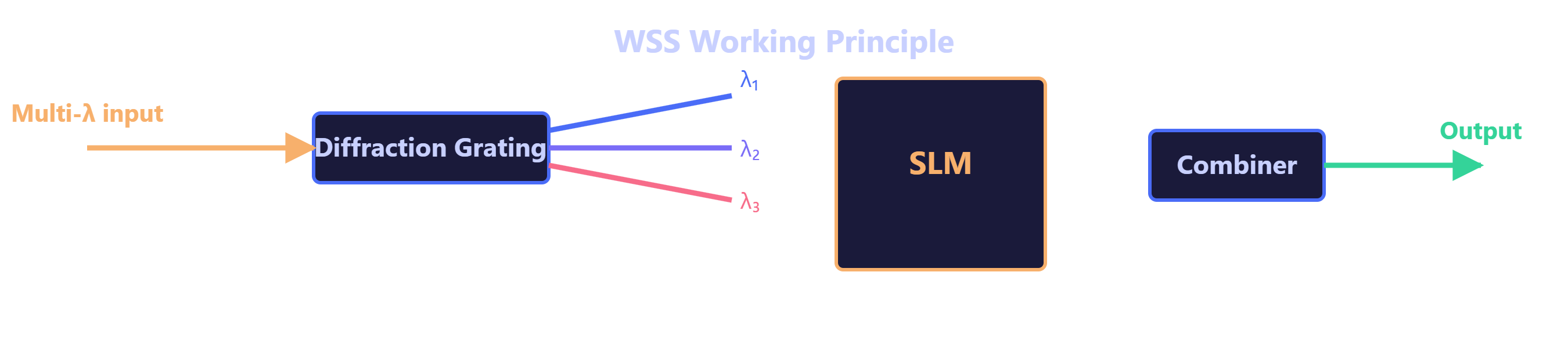
Figure 1: WSS principle: grating demux → SLM per-wavelength control → combining output
III. Three Technology Routes: MEMS / LC / LCoS
The switching mechanism determines switching speed, channel spacing, and port count. The three mainstream routes are: MEMS (micro-mirror array, e.g. Lumentum, 1×9, 50 GHz, 10-50 ms), Liquid Crystal (LC, phase shift/deflection, e.g. NTT/Fujitsu, 1×20, 25 GHz, 5-20 ms), and LCoS (Liquid-Crystal-on-Silicon phase modulation, e.g. Coherent, 1×32~1×64, 12.5 GHz, <5 ms). LCoS is regarded as the most promising route, with miniaturization and high-pixel-density LCoS providing underlying support for next-generation high-density WSS.
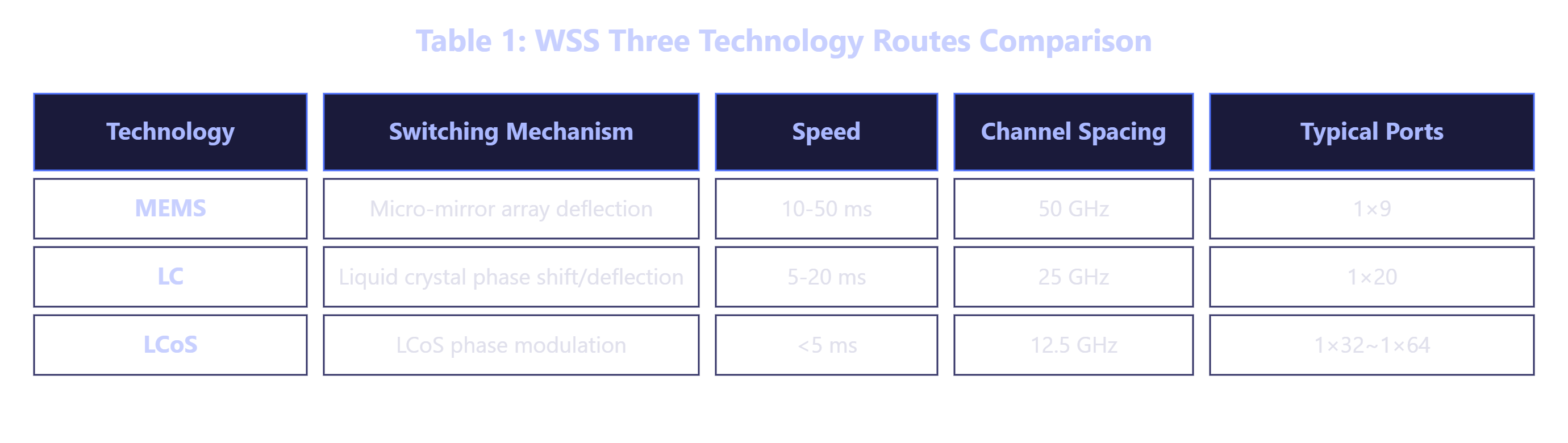
Figure 2: Comparison of WSS three technology routes
IV. From CDC-ROADM to C+L Band: Capacity-Doubling Engineering Practice
4.1 CDC-ROADM
WSS-based CDC-ROADM (Colorless, Directionless, Contentionless) achieves three breakthroughs: wavelength independence (any wavelength to any port), direction independence (any port to any direction), and contentionless (same wavelength on different ports without collision). Typically composed of WSS and MCS together, service provisioning shrinks from "days" to "minutes," supporting single-channel 400G+ ultra-high-speed transmission.
4.2 C+L Band Expansion
The standard C band offers about 4.8 THz (1530-1565 nm), carrying ~80 wavelengths at 50 GHz spacing. Extending to the L band creates C+L (≈1530-1625 nm, total ≈9.6 THz), nearly doubling the number of wavelengths. C+L WSS must maintain consistent dispersion, loss, and isolation across the extended band, imposing higher component requirements, but can double the per-fiber capacity without laying new cables.

Figure 3: C+L band expansion nearly doubles single-fiber capacity
V. AI Data Center Optical Switching Engine: OCS and All-Optical Switch
AI training clusters generate massive east-west traffic, where traditional electrical switching suffers high power, high latency, and high port cost. All-optical circuit switches (OCS), using WSS to dynamically schedule wavelengths or fiber links, enable high-speed interconnection with link capacities easily scaling to 800G/1.6T. OCS advantages: ultra-low power (all-optical, no O-E-O), ultra-low latency (no packet buffering/queuing), and programmable topology (μs~ms reconfiguration). WSS complements thin-film lithium niobate (TFLN) modulators, together forming the two pillars of all-optical interconnect for AI data centers.

Figure 4: WSS-driven all-optical switch architecture for AI data centers
VI. Industry Landscape and Localization Progress
WSS belongs to the most technologically challenging optical communication components. The Asia-Pacific region holds about 47% of the global market, followed by the Americas (~26%). Major manufacturers include Coherent, Lumentum, Molex, Santec, with top three accounting for ~96% of shipments. WSS, together with OPM (optical performance monitoring), EDFA, and MCS, forms the ROADM system. In recent years, the LCoS route continues to expand, and domestic WSS is rapidly approaching international advanced levels in port count, channel spacing, and insertion loss.
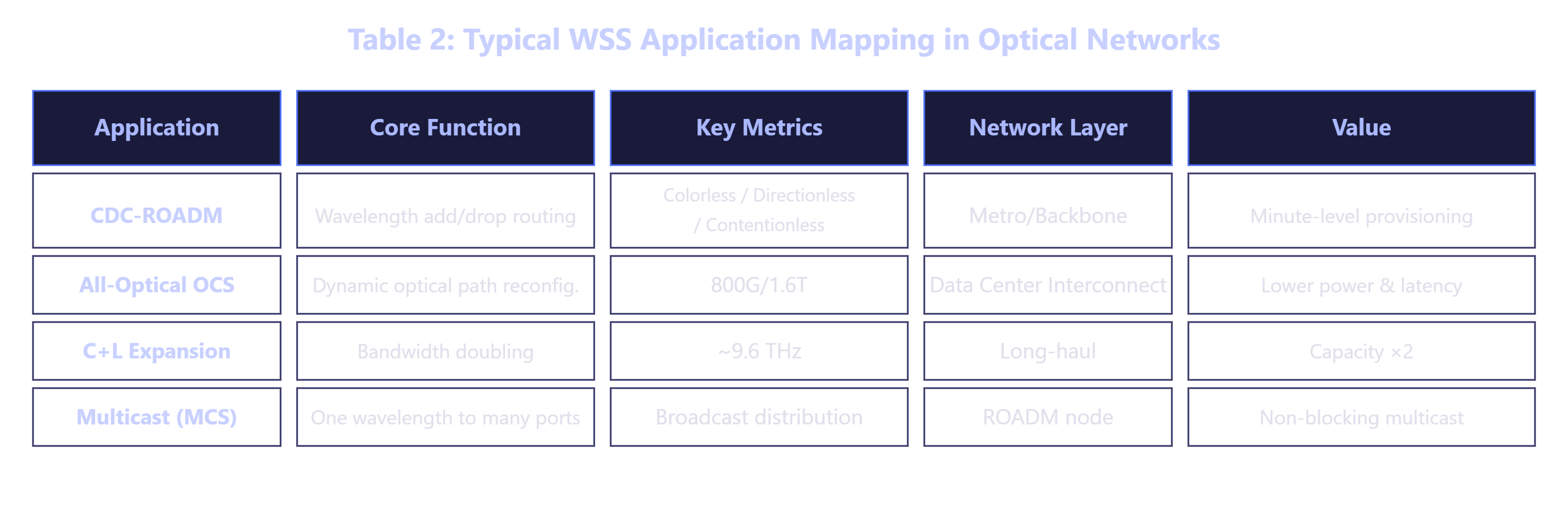
Figure 5: Typical WSS application mapping in optical networks
VII. Conclusion and Outlook: From "Pipes" to "Neural Networks"
The evolution of WSS is essentially a microcosm of optical networks moving from "fixed pipes" to "programmable neural networks." With a single device, it simultaneously solves wavelength routing, power balancing, and multicast distribution. Looking ahead, WSS will evolve in three directions: higher port counts and finer grids (1×64→1×128, flexible grids down to 6.25 GHz); photonic-electronic collaborative intelligent scheduling (WSS + AI controller + digital twin for autonomous optical networks); and large-scale penetration in data centers (OCS+WSS becoming standard in AI compute clusters, together with TFLN modulators and coherent DSPs defining the next-gen all-optical interconnect architecture). When every wavelength can be intelligently scheduled in milliseconds, optical fibers truly upgrade from "information highways" to "programmable optical neural networks."