
I. From Copper to Fiber: The Logic Behind Optical Access Network Upgrades
Over the past decade, global broadband networks have leapfrogged from 100 Mbps to 1 Gbps. China's FTTH penetration now exceeds 97%, and most urban households enjoy 100 Mbps to 1000 Mbps downstream bandwidth. Yet 1 Gbps is not the end — with 4K/8K ultra-HD video, Cloud VR, cloud gaming, AI inference services, and enterprise digital transformation, the bandwidth demand curve continues to rise exponentially.
Simultaneously, the large-scale deployment of 5G mobile networks is creating a new transmission demand scenario: fronthaul. The dense small-cell deployment of 5G requires far more fiber than 4G — every AAU needs its own optical link, placing unprecedented pressure on operators' infrastructure budgets.
These two demand curves — residential broadband upgrades and enterprise network evolution — point to the same technical direction: the construction of 10-Gigabit (10G+) optical access networks is accelerating. Directly Modulated Lasers (DMLs), as the most critical light source in these networks, are now facing unprecedented market opportunities.
II. DML vs. EML: Two Optical Modulation Paths
2.1 Direct Modulation: Simplicity is Power
Direct modulation is straightforward: modulating the injection current of a semiconductor laser directly changes the output optical power. This "direct-to-use" approach eliminates intermediate stages, offering structural simplicity, low power consumption, and cost control.
However, direct modulation comes with an unavoidable physical cost — chirp. When the injection current changes, the carrier concentration in the active region fluctuates, altering the refractive index and causing wavelength drift. The amount of drift is proportional to the modulation speed, and chirp severely limits transmission distance.
Chirp interacts with fiber chromatic dispersion: different wavelengths travel at different speeds, causing pulse broadening and signal degradation. This makes DMLs inherently suitable for short-reach applications — typically within 10 km, such as intra-data-center interconnects and 5G fronthaul.
2.2 Electro-absorption Modulation: The Cost of Precision
Electro-absorption modulated lasers (EMLs) decouple the two issues: the laser part emits a constant wavelength, while the electro-absorption modulator (EAM) controls absorption via bias voltage. Since modulation does not change the wavelength, EMLs have extremely low chirp, supporting longer distances (40 km or more) and higher speeds (25G+). However, the dual-region epitaxial structure increases complexity and cost, and the modulator requires continuous bias control.
2.3 Core Comparison
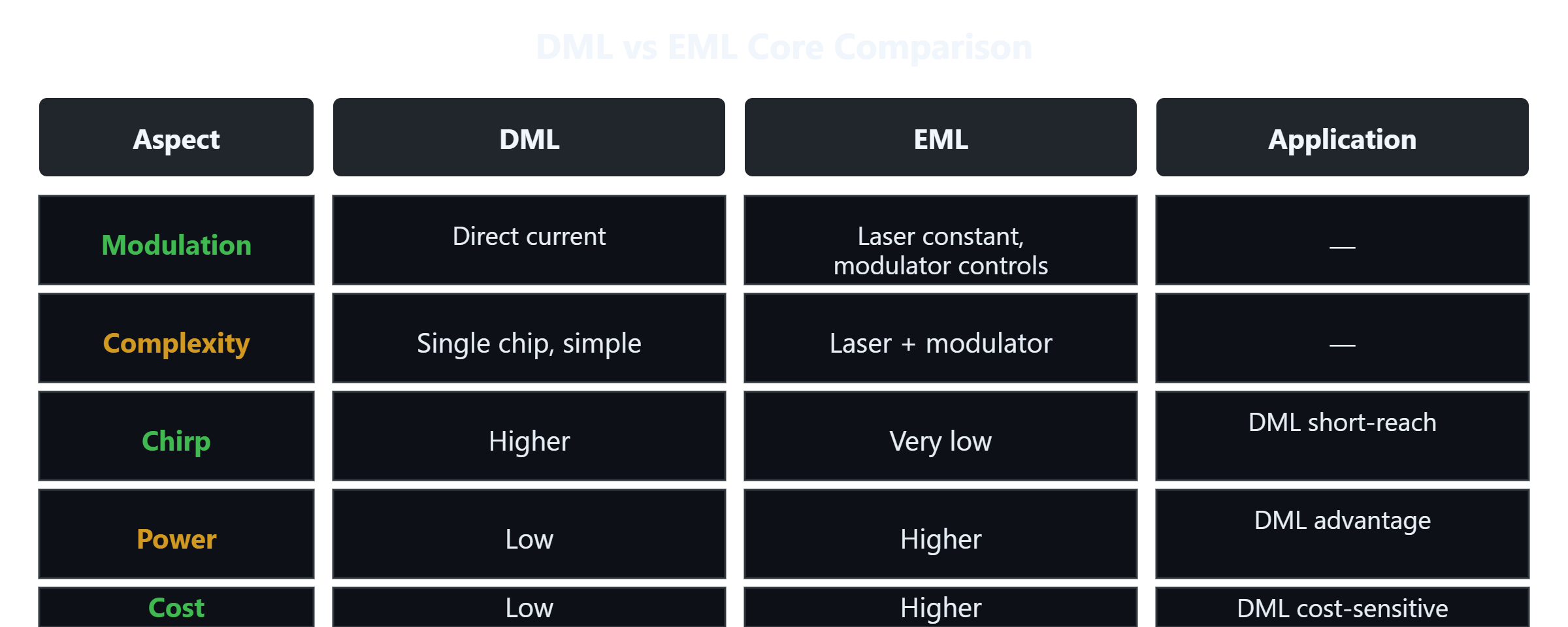
Figure 1: Core comparison between DML and EML
III. 5G Fronthaul: DML Opportunities under Massive Fiber Demand
3.1 Optical Device Challenges in Fronthaul
5G adopts C-RAN architecture, centralizing BBUs and distributing RRU/AAUs. Fronthaul demands ultra-high bandwidth and low latency. Massive MIMO dramatically increases fronthaul bandwidth, with 25 Gbps per channel becoming standard, and 50 Gbps/100 Gbps solutions already on the roadmap.
Operators widely deploy WDM to save fiber, with BiDi technology saving 50% of fiber resources. Tunable DWDM modules simplify spare parts management.
3.2 DML's Core Role in Fronthaul
In 5G fronthaul, DMLs provide stable 25 Gbps modulation. The 10-20 km reach requires sufficient output power, stable wavelength, and reliable TEC control. Commercial 1310 nm 25 Gbps DMLs deliver +8 dBm output, >6 dB extinction ratio, and stably support 10 km links.

Figure 2: 5G fronthaul network and DML position
3.3 The Future of 5G Fronthaul: Toward 50G and 100G
5G-Advanced is driving fronthaul to 50 Gbps per channel, requiring PAM4 modulation. PAM4 demands higher linearity from DMLs. Commercial 50 Gbps DMLs are expected to be deployed at scale around 2027-2028.
IV. 50G-PON: Commercial Progress and DML Demand
4.1 From 1G to 10G: The Evolution Logic of PON
Currently deployed 1-Gigabit networks are based on XG(S)-PON and 10G-EPON, supporting 10 Gbps downstream. 50G-PON is positioned as the next-generation standard, increasing single-wavelength capacity by 5×, with symmetric versions supporting 50 Gbps both ways.
4.2 50G-PON Commercial Progress: Pilot Deployment in 2025
In January 2025, China's MIIT issued a notice on 10-Gigabit network pilots, and the 50G-PON standard system is largely complete. China Mobile announced 50G-PON+FTTR as the core technology. In December 2025, Shanghai Telecom completed 50G-PON coverage procurement, and Guang'an Mobile launched the first "10-Gigabit park" with实测 download speeds exceeding 10 Gbps.
4.3 DML in 50G-PON: From 10G to 50G
50G-PON demands stable 50 Gbps modulation from DMLs. PAM4 modulation with 25 Gbps optics is the preferred path, but it imposes stricter requirements on chirp and driver design. Next-gen DMLs target >30 GHz bandwidth and are expected to reach commercial status around 2027.
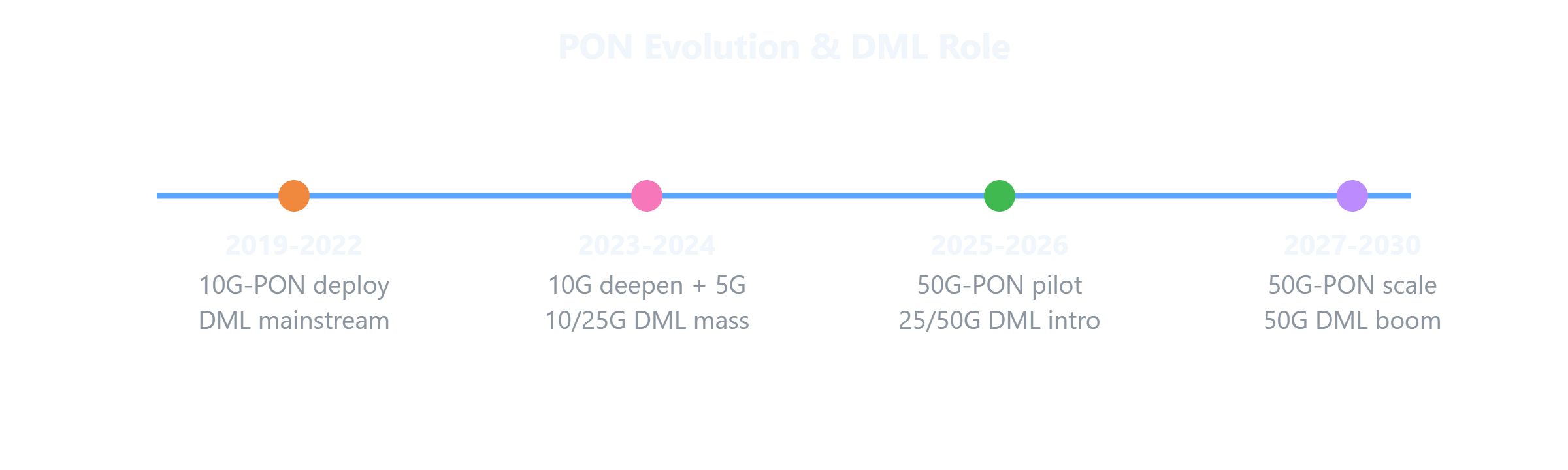
Figure 3: PON evolution timeline and DML deployment
V. Technology Breakthrough: NTT Pushes DML Bandwidth Limit
5.1 World's First >100 GHz Directly Modulated Laser
In May 2026, NTT and Tokyo Tech announced a DML with 3-dB bandwidth exceeding 100 GHz, using InP material and SiC substrate with 3× better heat dissipation. They achieved 256 Gbps error-free transmission over 2 km, setting a new record. This validates DML's potential for ultra-high-speed interconnects and 6G fronthaul.

Figure 4: NTT 100 GHz DML breakthrough and commercial outlook
5.2 From Lab to Fab
Transitioning from a 100 GHz lab device to mass production requires solving epitaxial uniformity, chip testing, packaging yield, and reliability qualification. However, the demonstration already shows the direction for commercial DML evolution.
VI. Commercial DML Product Portfolio & Selection Guide
6.1 Mainstream Products for Current Deployment
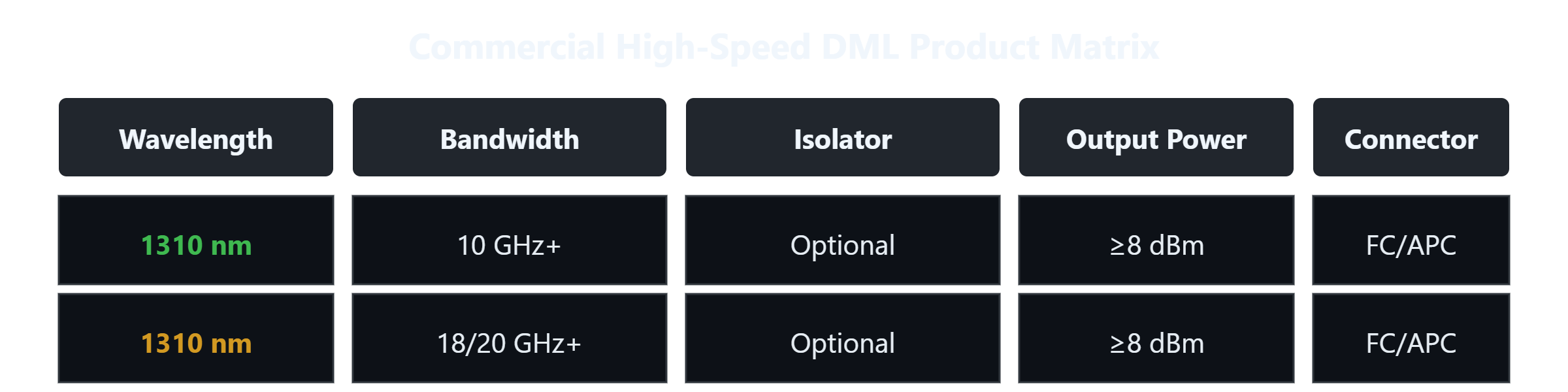
Figure 5: Commercial high-speed DML product matrix
6.2 Isolator Selection: To Include or Not
Isolators block reflected light to protect laser stability. For well-designed internal modules with sufficient return loss margin, isolator-free saves ~0.5-1 dB loss and cost. For outdoor deployment with uncertain reflections, isolator-integrated versions are safer.

Figure 6: DML isolator selection guide
6.3 Packaging and Connectivity: Standardization & Compatibility
The 7-pin butterfly package integrates TEC and thermistor for precise temperature control. The RF interface uses a 2.92 mm (K-type) coaxial connector supporting up to 40 GHz, which has become the industry standard for 25 Gbps+ DMLs.
VII. Summary and Outlook
High-speed DMLs are at a dual inflection point of technology and market. From 5G fronthaul mass deployment to 50G-PON commercialisation, DMLs have secured an irreplaceable position in 10-Gigabit optical access networks, thanks to their cost and power advantages.
Looking ahead, DML technology will advance along two parallel tracks: (1) continuously increasing modulation bandwidth through material innovation and structural optimisation, from today's 20 GHz class to 30 GHz, 50 GHz and beyond; and (2) introducing higher-order modulation like PAM4 to double system capacity at the same device speed.
NTT's 100 GHz DML demonstration already shows that the speed limits of directly modulated lasers are far from reached. With the synergy of 5G-Advanced, 50G-PON, and next-generation data centre interconnects, DMLs will play an ever more critical role in optical network infrastructure over the next decade.