
Semiconductor Laser Linewidth and Coherence: Principles, Measurement, and Applications(Quantum Noise · Coherence Length · Measurement Techniques · Engineering Selection)
When Maiman demonstrated the first ruby laser in 1960, people marveled at the laser’s near-perfect monochromaticity. However, as laser technology matured, engineers gradually realized that no laser spectrum is truly infinitely narrow. Quantum noise, carrier fluctuations, mechanical vibrations, and temperature drift all contribute to the practical linewidth.
Spectral linewidth is the key metric for monochromaticity and determines performance in coherent communications, interferometric sensing, and LiDAR. Narrower linewidth means longer coherence length, enabling better phase preservation over long distances. For FP lasers, understanding linewidth behavior is crucial: they typically exhibit a broad multi-longitudinal-mode spectrum (2-5 nm), which can actually be advantageous in low-coherence applications such as broadband sources for WDM-PON.
This article systematically introduces the physics of laser linewidth and coherence, measurement methods, application requirements, and practical selection guidelines.
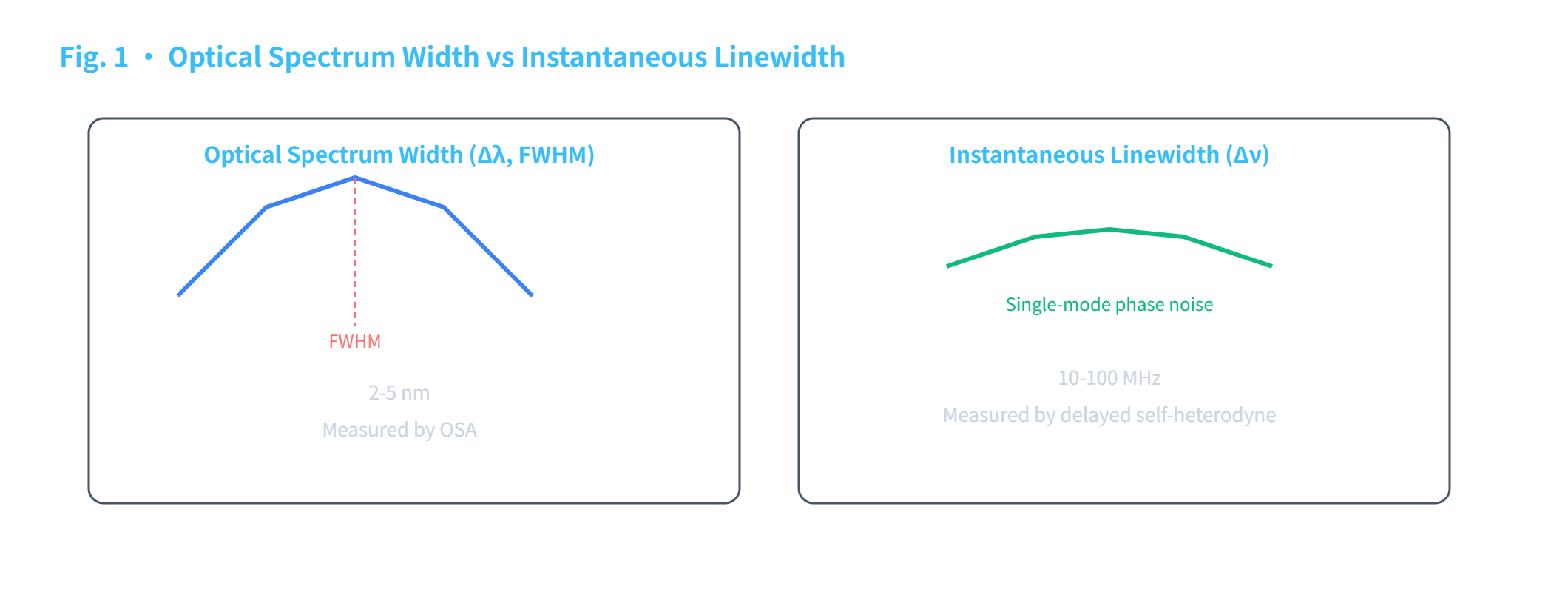
Optical spectrum width (OSA) and instantaneous linewidth (coherence) are different metrics; choose based on application
1. Physical Fundamentals of Linewidth and Coherence
1.1 Definitions
Optical spectrum width (Δλ): FWHM of emission spectrum measured by OSA; typical FP laser 2-5 nm, determined by multi-longitudinal-mode envelope.
Instantaneous linewidth (Δν): phase-noise width of a single longitudinal mode; typical FP laser 10-100 MHz, critical for coherent applications.
1.2 Schawlow-Townes Formula
The theoretical quantum-noise limit for single-mode lasers is Δν_ST = (4π·h·ν·n_sp·Δν_cavity)/P.
Example:
DFB laser theoretical ~1 kHz (P=10 mW), but practical values 100 kHz-10 MHz due to technical noise.
FP lasers have larger Δν_cavity (shorter cavity) thus wider theoretical linewidth (~18 kHz), but actual values reach 10-100 MHz due to mode competition.
1.3 Coherence Length and Coherence Time
Coherence time τ_c = 1/(π·Δν); coherence length L_c = c·τ_c/n.
Examples:
Δν=1 MHz → L_c≈95 m;
Δν=50 MHz → L_c≈1.9 m;
SLD Δν=20 THz → L_c≈4.8 μm.
Engineering implication: optical path difference must be much smaller than L_c to obtain clear interference fringes; long-range interferometry requires narrow linewidth.
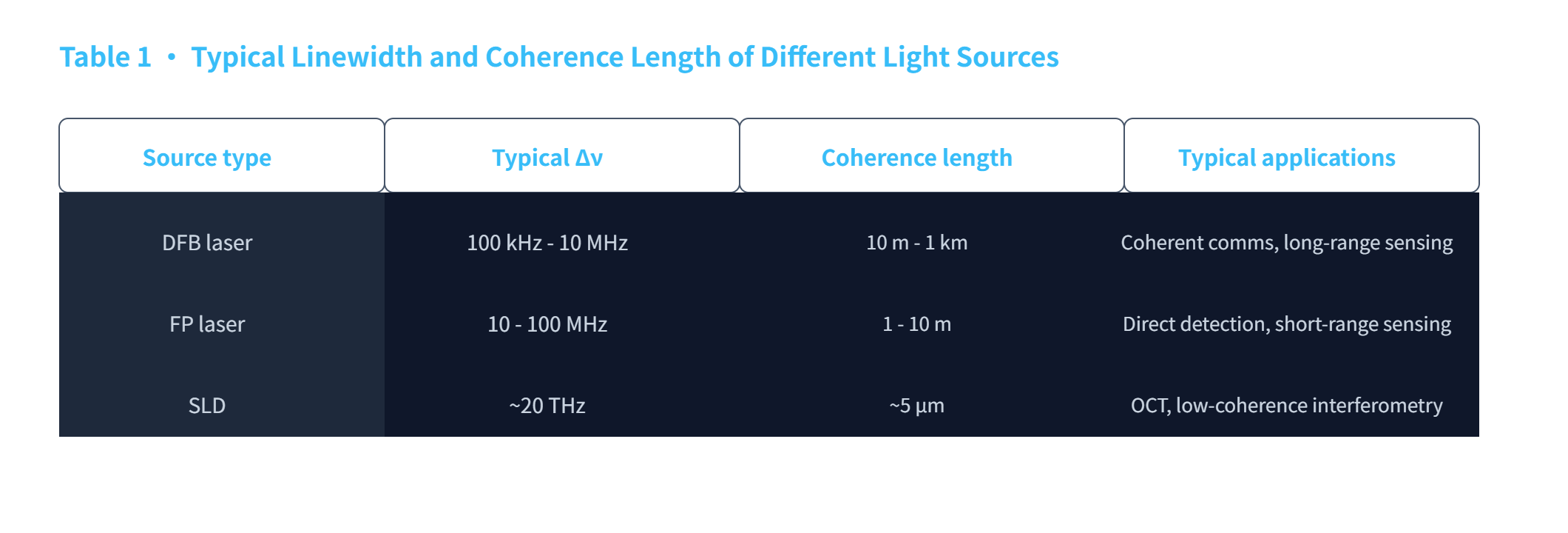
Narrower linewidth gives longer coherence length, suitable for long-range interferometric applications
2. Linewidth Measurement Techniques
2.1 Delayed Self-Heterodyne Method (Gold Standard)
Principle: split the laser into two paths, one through a long fiber delay, the other frequency-shifted by an AOM; beat the two and analyze the beat note spectrum. Delay must be >> coherence time.
Advantages: high accuracy (sub-kHz), international standard;
disadvantages: long fiber needed, system bulky. Recommended for DFB or narrow-linewidth FP lasers.
2.2 Fabry-Pérot Interferometer
Suitable for 100 kHz-1 GHz range; measure transmission peak width with high-finesse F-P etalon and deduce linewidth from finesse. Simpler system, real-time measurement, but requires high-quality etalon.
2.3 Direct OSA Measurement
Standard OSA resolution ~0.01 nm (1.25 GHz), can only measure FP laser envelope (2-5 nm) or broad DFB (>1 GHz); cannot measure narrow linewidth (<100 MHz). High-resolution VIPA-based OSA can achieve 1 MHz resolution but is expensive. For FP lasers, OSA measurement of spectrum width is the most common customer requirement; for narrow linewidth, DFB or external-cavity solutions are recommended.
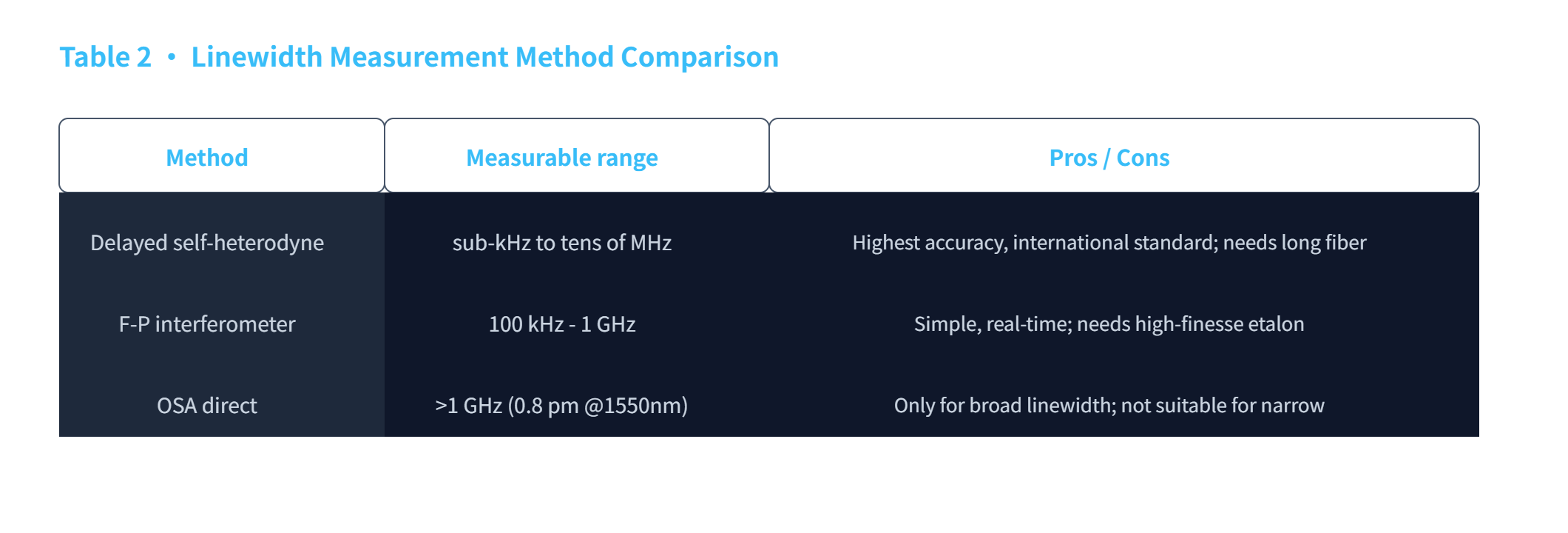
Choose measurement method based on expected linewidth; delayed self-heterodyne is best for narrow linewidth
3. Impact of Linewidth on Applications
3.1 Coherent Optical Communications
Transmit and LO linewidth must be<100 kHz (16QAM) to <1 MHz (QPSK). Excess linewidth increases phase noise, constellation rotation, and BER. FP lasers are too broad; custom DFB or external-cavity solutions are recommended.
3.2 Distributed Fiber Sensing
Φ-OTDR requires Δν
3.3 LiDAR
ToF LiDAR has no strict linewidth requirement; FP lasers are suitable. FMCW LiDAR requires Δν<100 kHz; narrow-linewidth lasers are needed. 1550 nm FP-LD with self-injection locking can be used for low-cost FMCW.
3.4 Spectroscopy and Gas Sensing
TDLAS: at atmospheric pressure, gas absorption linewidth is several GHz, FP lasers (tens of MHz) are suitable; under low pressure, DFB (<10 MHz) is needed. Raman spectroscopy requires Δλ<0.1 nm; FP lasers are too broad.
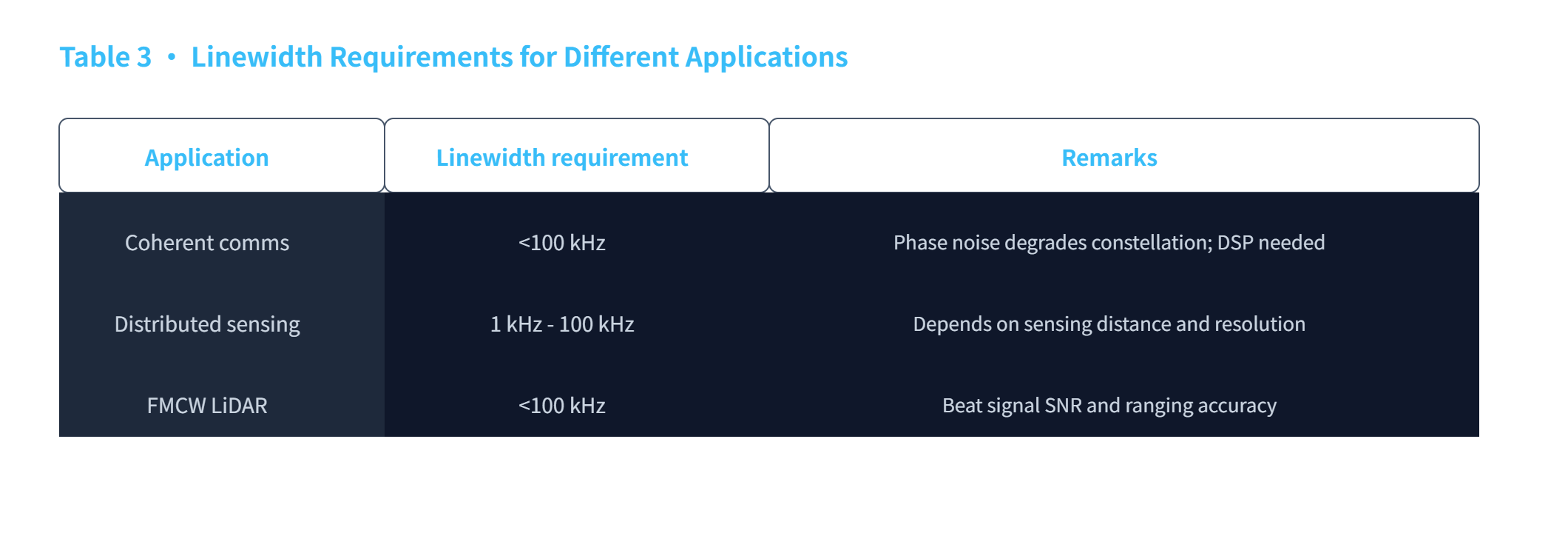
Linewidth requirements vary widely; select laser based on specific application needs
4. Techniques for Linewidth Narrowing
4.1 External Optical Feedback
Grating feedback (Littrow/Littman): narrows to 10-100 kHz, wavelength tunable.
FBG feedback: narrows to 100 kHz-1 MHz, simple structure.
Self-injection locking (SIL): using high-Q micro-cavity or FBG, narrows by 10-1000×, power almost unchanged. FP lasers can be customized with SIL for narrow linewidth.
4.2 DFB and DBR Structures
DFB lasers have built-in grating, linewidth 100 kHz-10 MHz, single-mode stable, higher cost. DBR lasers have gratings at the ends, wavelength tunable.
4.3 Other Techniques
Optical phase-locked loop (OPLL) for metrology; injection locking uses a narrow-linewidth master to suppress slave linewidth, achieving high-power narrow-line output.
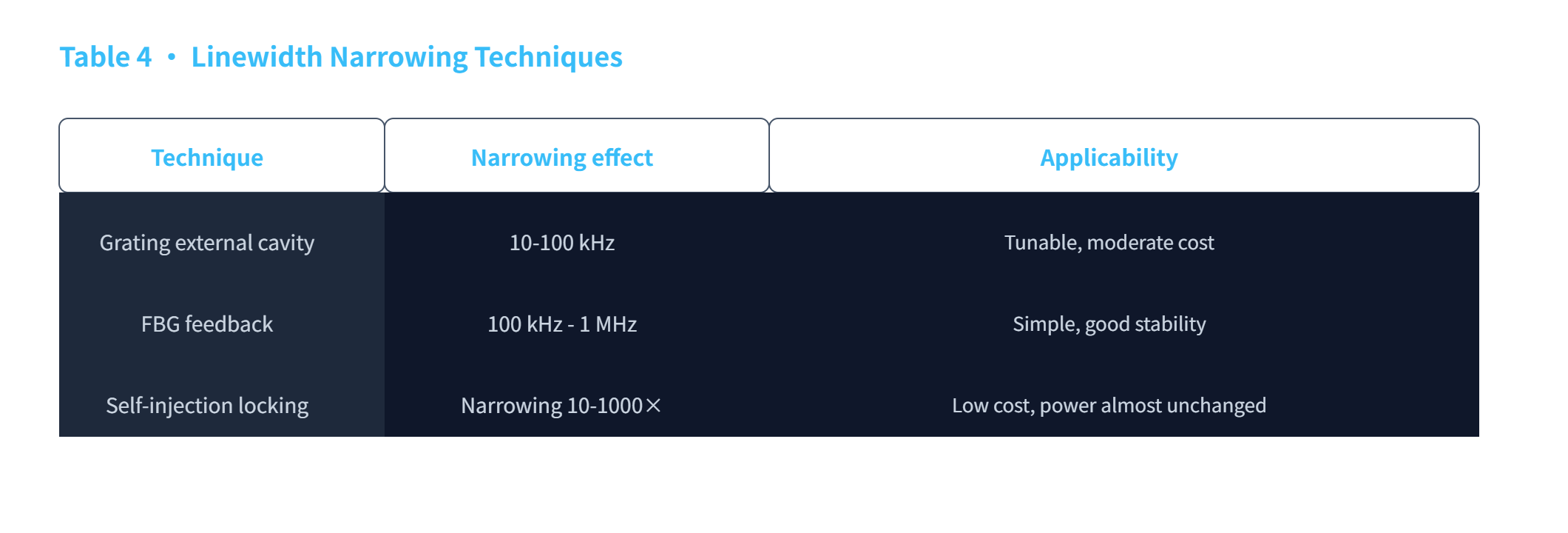
Self-injection locking is a cost-effective way to narrow FP laser linewidth for moderate-performance applications
5. Product Selection Guide
Recommendation based on linewidth requirement:
Broad linewidth (optical width 2-5 nm acceptable): standard FP lasers, wavelength 405-2000 nm, for direct detection, ToF LiDAR, industrial pumping, lighting/indication.
Medium linewidth (: FP laser + external feedback module, or custom DFB, for medium-range sensing, low-cost FMCW LiDAR, atmospheric gas sensing.
Narrow linewidth (: custom DFB or external-cavity laser (ODM service), for coherent communications, long-range distributed sensing, high-precision FMCW LiDAR, optical frequency comb pumping.
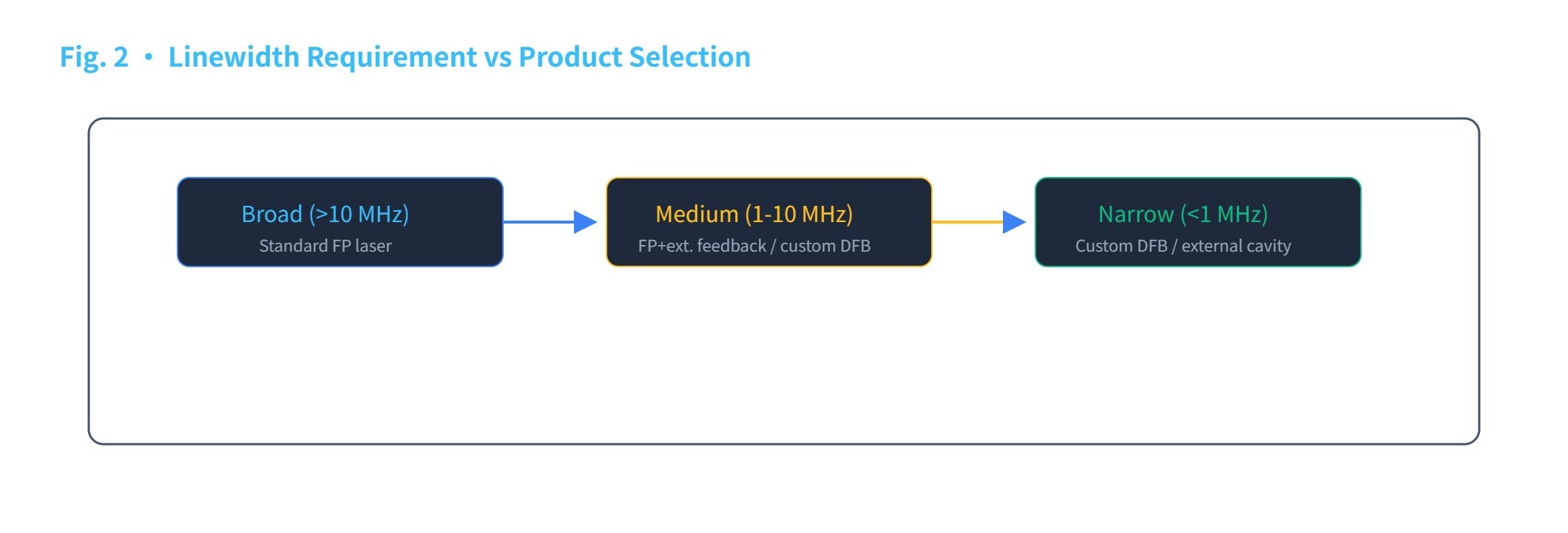
Select laser class based on linewidth and coherence length needed for the target application
6. Summary
Linewidth and coherence are fundamental characteristics of semiconductor lasers, determining their performance in advanced applications.
This article has covered the distinction between optical spectrum width and instantaneous linewidth, the Schawlow-Townes formula and coherence length, three main measurement methods (delayed self-heterodyne, F-P interferometer, OSA) and their applicability, the impact of linewidth on coherent communications, distributed sensing, LiDAR, and gas sensing, and linewidth narrowing techniques such as external feedback, DFB/DBR, and injection locking.