
Semiconductor Laser Array Technology and Multi-Channel Parallel Light Sources (Breaking Bandwidth Bottlenecks · High-Density Integration · Core Light Source for Parallel Transmission).
As optical communication evolves toward 100G, 400G and even 800G, the bandwidth limitation of single-channel lasers becomes increasingly critical. Parallel transmission - sending and receiving data through multiple channels simultaneously - has become the core strategy to overcome bandwidth constraints.
One fiber carries multiple signals, one module integrates multiple light sources - this is the application background of semiconductor laser array technology. Semiconductor laser arrays integrate multiple independent laser units on a single chip or within a single package to achieve multi-channel parallel emission. Compared with single-emitter lasers, array devices offer significant advantages in bandwidth density, system integration and cost efficiency. However, array integration also introduces new technical challenges: thermal crosstalk management, channel uniformity control, trade-offs between packaging density and heat dissipation capability.
This article systematically introduces the technical architecture of semiconductor laser arrays, including one-dimensional and two-dimensional device structures, thermal management design, packaging integration schemes, and typical applications in high-speed optical communication and solid-state LiDAR.
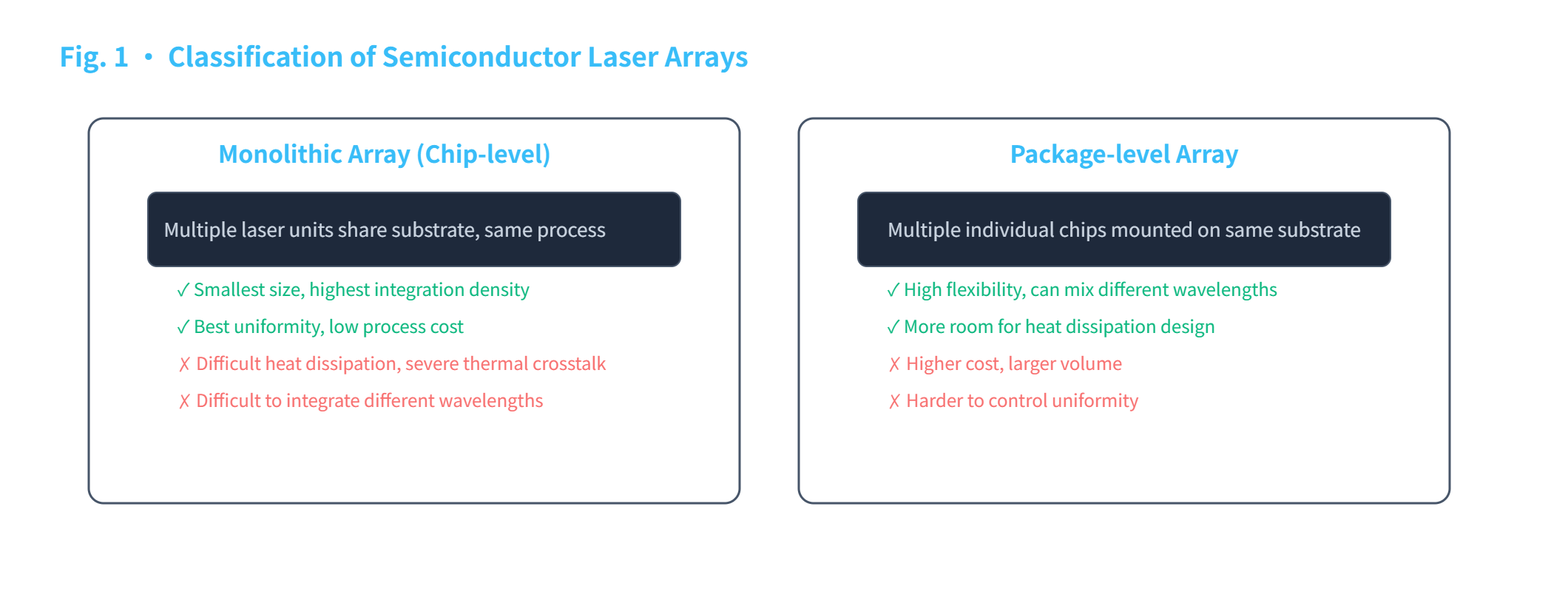
Monolithic arrays pursue high density; package-level arrays offer flexibility and better thermal performance
1. Fundamentals of Laser Arrays
1.1 Why Array Integration?
Single semiconductor lasers have direct modulation bandwidth around 1-5 GHz (FP) or 10-15 GHz (DFB), insufficient for 100G/400G requirements. Parallel transmission splits high-speed data into multiple lower-speed substreams transmitted through multiple channels. Typical parallelism includes 4 channels (100G LR4), 8 channels (400G SR8), and 16 channels (800G OSFP). Using discrete lasers would lead to large size, high power consumption, high cost and poor uniformity. Laser arrays integrate multiple laser units on a single chip or within one package, offering the optimal solution.
1.2 Array Classification
Monolithic (chip-level) arrays: multiple laser units grown on the same epitaxial wafer, sharing the substrate. They achieve smallest size and best uniformity but suffer from heat dissipation and thermal crosstalk. Package-level arrays: multiple individual chips mounted on a common substrate, offering high flexibility and better thermal design, but cost and volume are higher. Geometric arrangements include one-dimensional linear arrays (127 μm or 250 μm pitch) and two-dimensional area arrays.
1.3 Typical Array Specifications
4-channel arrays (127 μm pitch, LAN-WDM or CWDM4 wavelengths); 8-channel arrays (400G SR8); 12-channel and beyond (for ultra-high-speed parallel transmission). We provide customized multi-channel FP laser array solutions.
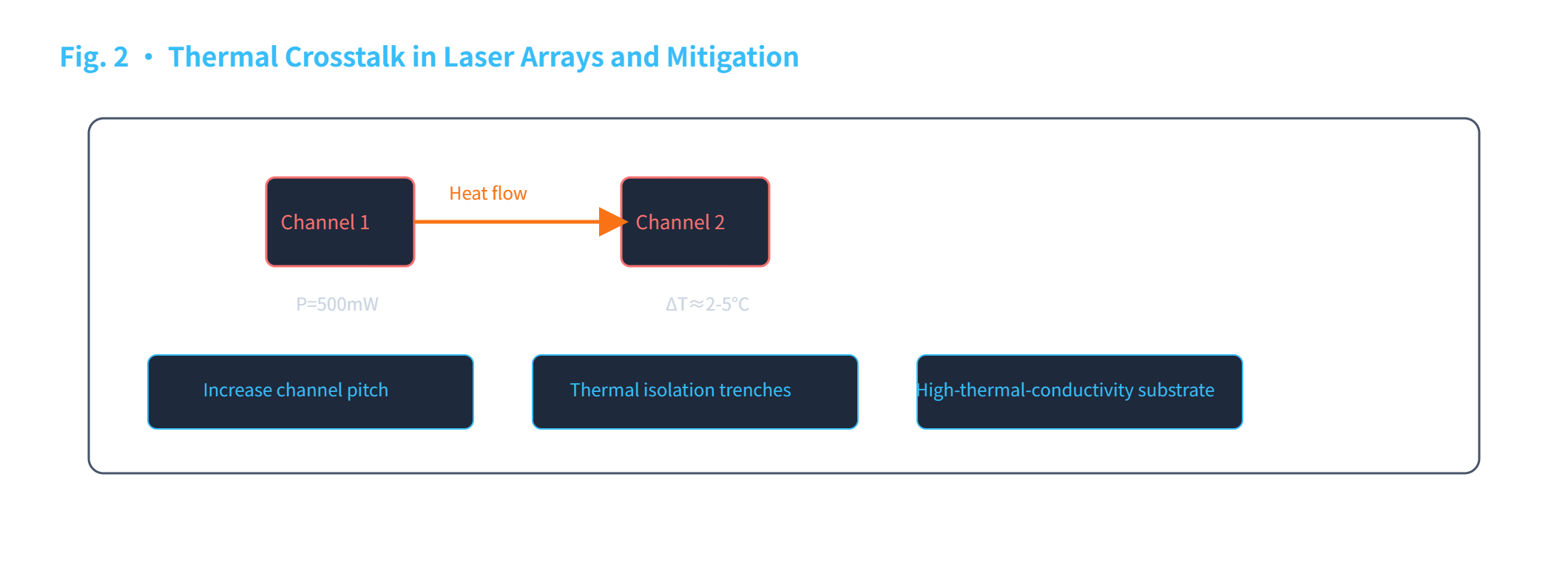
Thermal crosstalk increases adjacent-channel threshold current, power fluctuation and wavelength shift; mitigation through trenches or high-thermal-conductivity substrates
2. Monolithic Array Technology
2.1 Array Chip Structure
Monolithic arrays share the same epitaxial layers, with ridge waveguides providing lateral optical confinement. Typical ridge width 2-5 μm, ridge pitch determined by array pitch (127 or 250 μm). Cleaved facets are coated with AR or HR films to improve output efficiency.
2.2 Thermal Crosstalk and Management
Thermal crosstalk raises adjacent-channel threshold current, causes power fluctuation and wavelength shift. Mitigation strategies: increase channel pitch, etch thermal isolation trenches (width 10-50 μm, depth several to tens of micrometers), use high-thermal-conductivity substrates (SiC, diamond, copper-diamond composites), or interleaved operation. For high-power arrays, we recommend a combination of thermal isolation trenches and high-thermal-conductivity substrates.
2.3 Channel Uniformity Control
Uniformity requirements: threshold current deviation <±10%, output power deviation <±15%, wavelength deviation <±3 nm, far-field angle deviation <±2°. Control measures include epitaxial wafer screening, process monitoring, chip sorting and electrical compensation (independent drive adjustment).
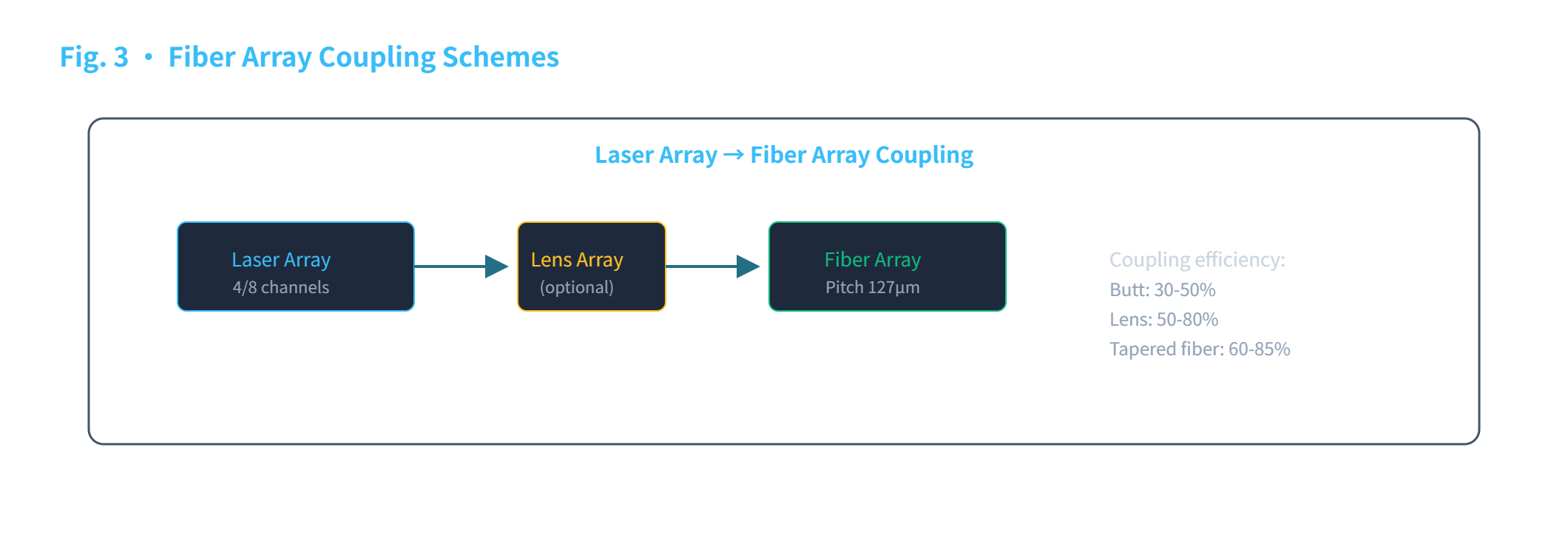
Fiber array coupling is critical for array packaging; microlens arrays can significantly improve coupling efficiency
3. Package-Level Arrays and Integration Technology
3.1 Multi-Chip Package Arrays
When monolithic arrays cannot meet requirements, multi-chip packaging is used: multiple independent laser chips mounted on a common substrate. Advantages: high flexibility (mixed wavelengths), more thermal design space, higher yield. Disadvantages: higher cost, larger size, harder uniformity control. We offer butterfly-package multi-channel products with custom wavelength combinations.
3.2 Fiber Array Coupling
Standard fiber arrays: 4/8/12/16 channels, pitch 127 μm or 250 μm, single-mode or multimode fiber. Coupling schemes: butt coupling (30-50%), lens array coupling (50-80%), tapered fiber array coupling (60-85%). Alignment process: coarse alignment (±5 μm) → fine alignment (six-axis stage, ±0.5 μm) → fixation (UV epoxy or laser welding) → verification. We provide matching fiber array components and coupling alignment services.
3.3 Internal Optical Integration
Typical integrated link: laser array → microlens array → multiplexer (AWG or thin-film filter) → isolator array → fiber array. Example: 4-channel CWDM transmitter module (1270/1290/1310/1330 nm) using a multiplexer to combine into a single output fiber. Integration challenges include space constraints, alignment accuracy, thermal management and reliability. Solutions: monolithic integrated optical platforms, precision active alignment, and parallel curing processes.
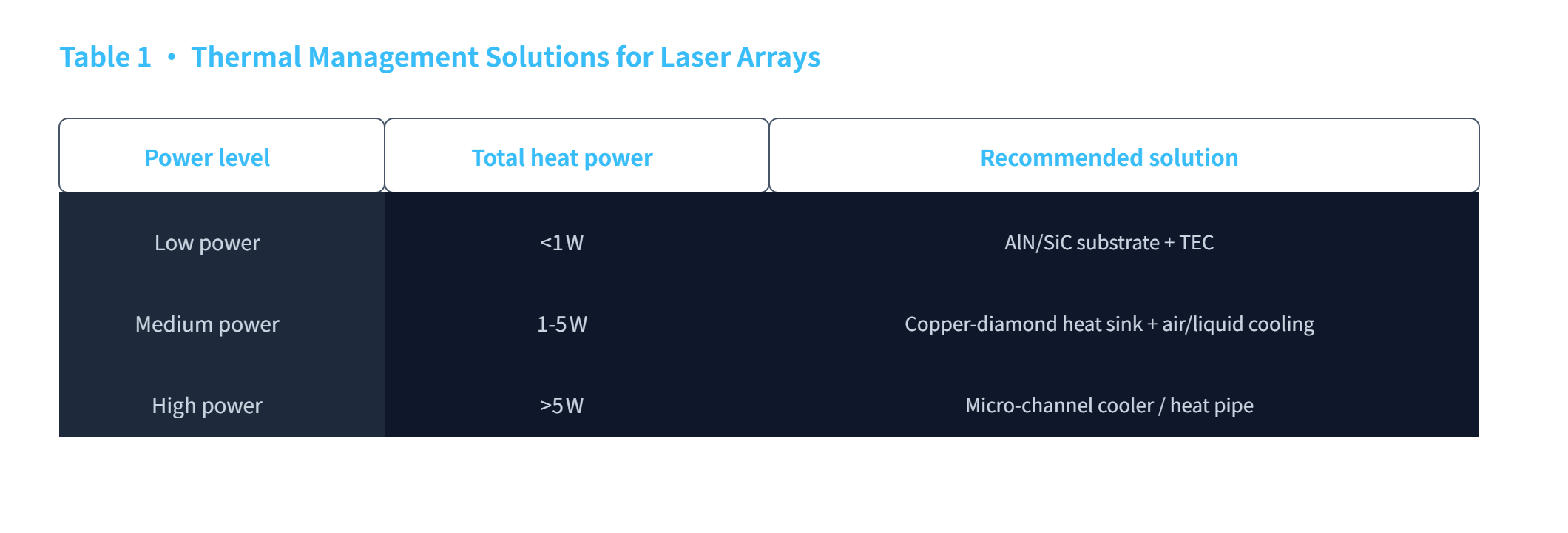
Select appropriate cooling solution based on total array heat power to keep junction temperature within safe limits
4. Typical Applications
4.1 High-Speed Optical Communication
100G LR4/ER4/ZR4: 4 channels × 25 Gbps, LAN-WDM wavelengths. 400G DR4/FR4/LR4: 4 channels × 100 Gbps, CWDM wavelengths. 400G SR8: 8 channels × 50 Gbps, 850 nm VCSEL or 1310 nm FP arrays. We offer 1310 nm and 1550 nm FP laser arrays as light sources for 400G short-reach parallel links, and can customize multi-wavelength array solutions.
4.2 Solid-State LiDAR
Flash LiDAR uses area-array lasers (905 nm or 1550 nm VCSEL/FP arrays) to illuminate the entire field of view, combined with area-array detectors, no mechanical scanning. Optical-phased-array (OPA) LiDAR steers the beam electronically. We provide 905 nm and 1550 nm FP laser arrays with customizable channel count, pitch and power.
4.3 Laser Printing and Display
Laser printing: 780 nm or 850 nm, single-channel or 4-8 channel arrays, 50-200 mW per channel. Laser projection: RGB laser arrays (450 nm + 520 nm + 635 nm), each colour with multiple channels to increase power and brightness uniformity. We offer visible-light FP laser arrays (450 nm, 520 nm, 635 nm) for laser display applications.
4.4 Medical and Biomedical Detection
Optical coherence tomography (OCT) requires multi-wavelength sources (850/1050/1310 nm); flow cytometry needs multiple wavelengths (405/488/561/635 nm) to excite various fluorescent markers; photodynamic therapy (PDT) uses multi-wavelength sources to match different photosensitizers. Our FP laser product line covering 405-2000 nm can be flexibly combined to build multi-wavelength array light sources.
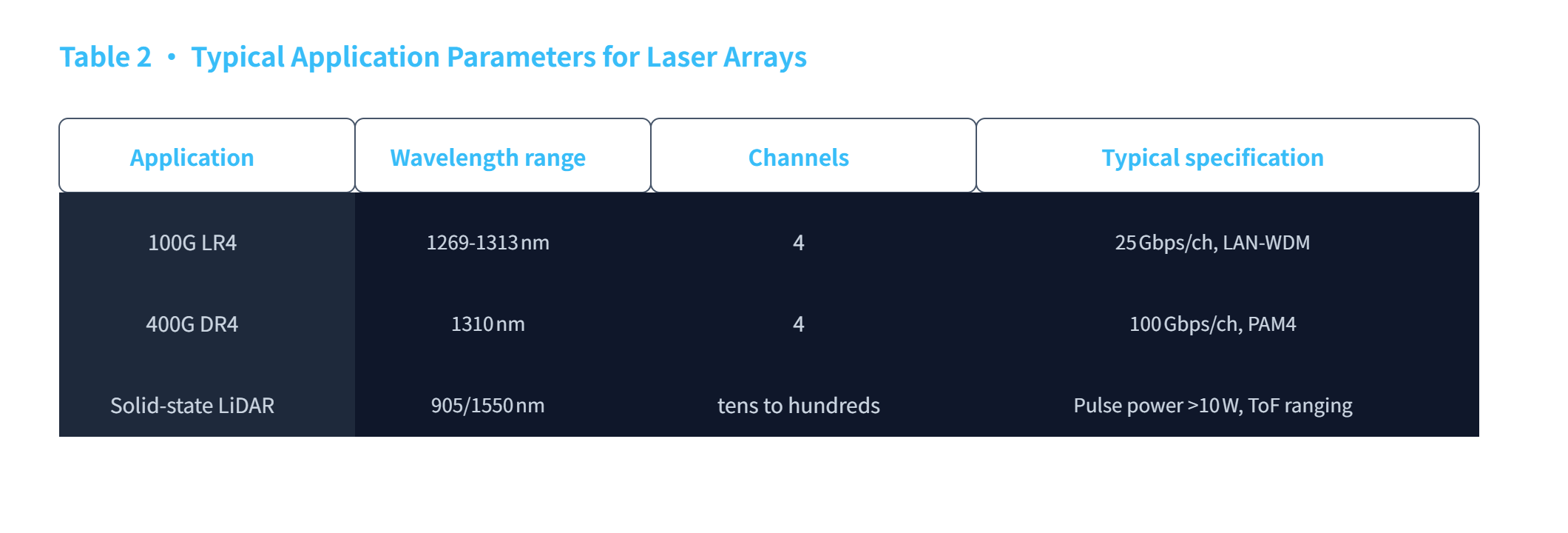
Different applications have specific requirements on wavelength, channel count and modulation format
5. Design Considerations for Laser Arrays
5.1 Thermal Design
Total heat power = N × P_channel × (1‑η). Example: 4 channels, 100 mW each, η = 30%, total heat ≈0.92 W. Low power (<1 W): AlN/SiC substrate + TEC. Medium power (1‑5 W): copper‑diamond heat sink + air/liquid cooling. High power (>5 W): micro‑channel cooler / heat pipe.
5.2 Electrical Design
Each channel requires an independent low-noise constant-current source. High-speed applications need impedance matching (50 Ω or 100 Ω differential lines) and electrical isolation between channels to reduce crosstalk. Laser arrays have higher ESD risk; independent ESD protection circuits or strict handling procedures are necessary.
5.3 Channel Testing and Sorting
Test items: P-I-V curves, spectral characteristics, threshold current, far-field pattern, modulation response (if applicable). Sorting strategy: if all channels pass → normal shipment; if some channels fail → mark bad channels and sell at reduced grade (e.g., 8-channel → 6-channel) or scrap entire device depending on application. Outlier channels require root-cause analysis for process feedback.
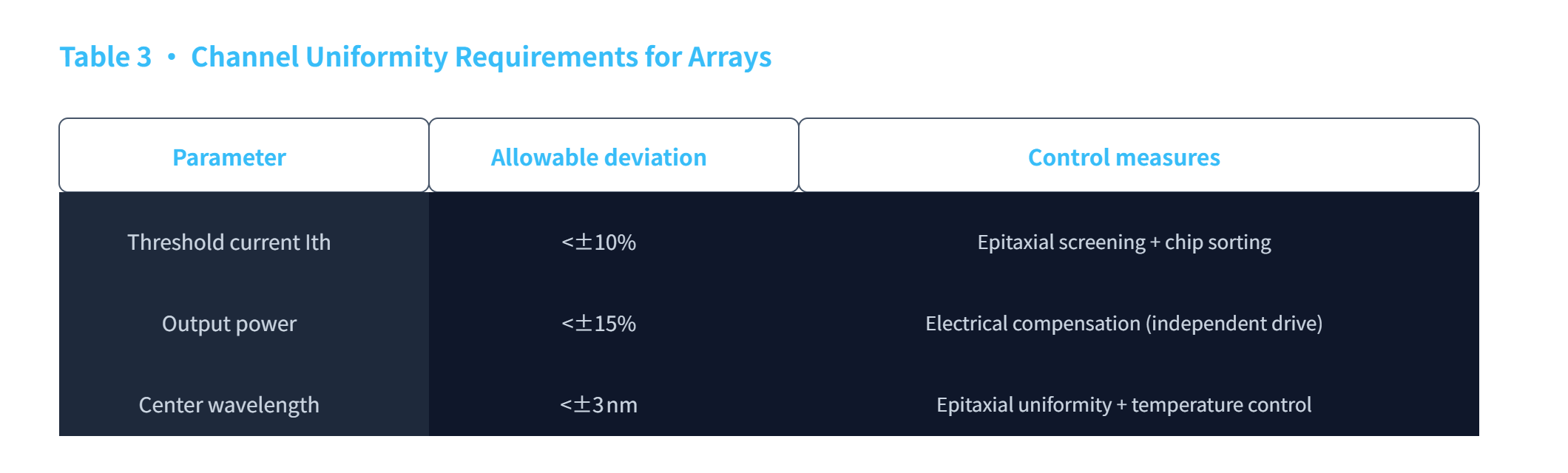
Channel uniformity is fundamental for volume deployment of array devices; it requires full control from epitaxy, process to driver circuits
6. Conclusion
Semiconductor laser arrays are the core devices enabling high-bandwidth, high-density optical interconnects. By emitting through multiple parallel channels, array devices break the bandwidth bottleneck of single-channel lasers and have become key enablers for advanced systems such as 400G/800G optical modules and solid-state LiDAR. Array integration introduces new challenges including thermal crosstalk, channel uniformity and high-density heat dissipation, which must be addressed through co-optimization at the chip structure, packaging process and system architecture levels.
This article has reviewed the core technical aspects: monolithic and package-level array structures, thermal crosstalk mitigation, fiber array coupling, typical applications and design guidelines. As data communication bandwidth continues to grow and autonomous driving technology rapidly evolves, the application space for laser arrays will expand further.
We are committed to advancing array technology, offering higher channel count, higher power density and lower thermal crosstalk array laser products to support the continuous upgrading of optoelectronic systems.