
Semiconductor Laser Packaging Technology(Die Attach · Wire Bonding · Fiber Coupling · TO-CAN / Butterfly / COB)。
Semiconductor laser bare dies measure only a few hundred micrometers. Packaging is the critical step that transforms them into commercial products. It determines electrical connection, thermal management, optical coupling, mechanical protection and environmental isolation – often accounting for more than 50% of device cost.
This article systematically introduces core packaging processes and mainstream package types, helping engineers understand and select appropriate solutions.
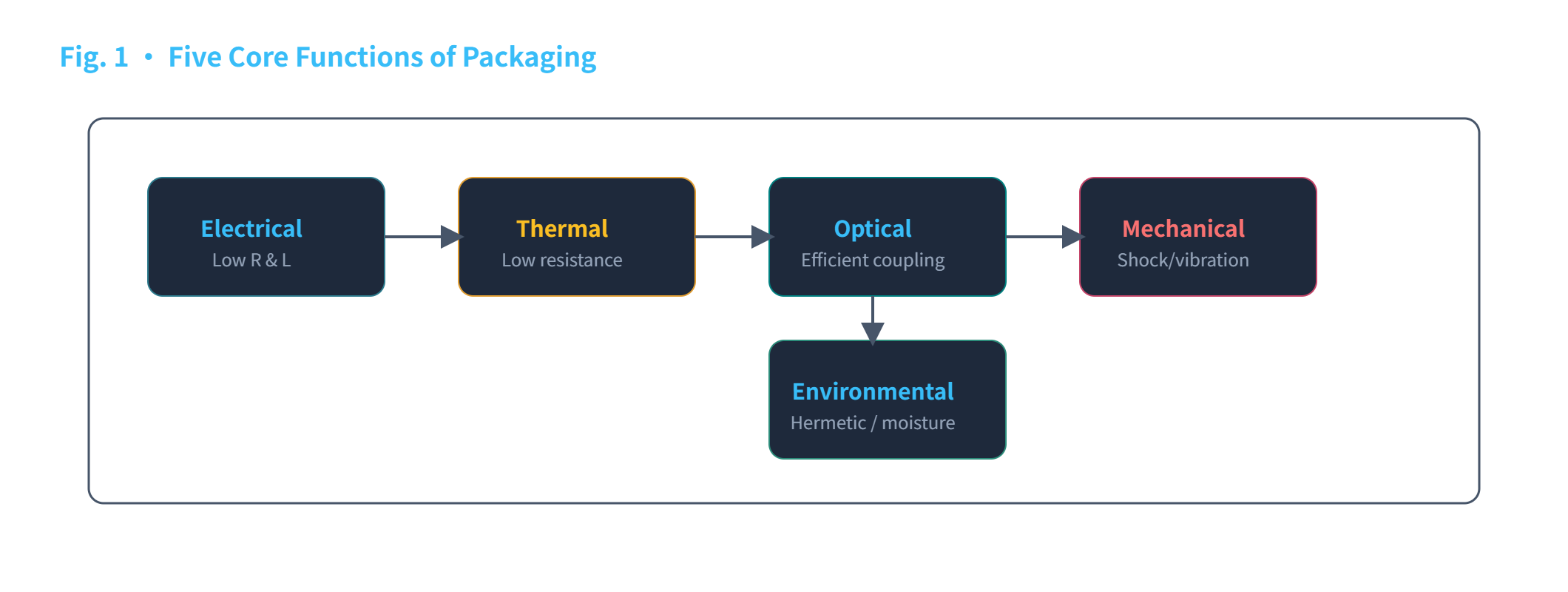
Packaging fulfills five essential functions: electrical, thermal, optical, mechanical and environmental
1. Packaging Process Overview
Typical FP laser packaging flow: die inspection & sorting → die attach → wire bonding → fiber coupling & fixation → optical alignment & lens assembly → sealing → optical test & screening → burn-in & final test.
2. Die Attach Process
Die attach fixes the laser chip onto the submount or heat sink.
AuSn solder (Au80Sn20): eutectic 280°C, thermal conductivity ~57 W/m·K; excellent thermal and mechanical properties for high-reliability devices.
Conductive epoxy: cure 150-200°C, ~3-5 W/m·K; low cost but poor long-term reliability; suitable for low-power or prototyping.
Indium solder: melting point 156°C, good ductility to relieve CTE mismatch, but lower strength and electromigration risk.
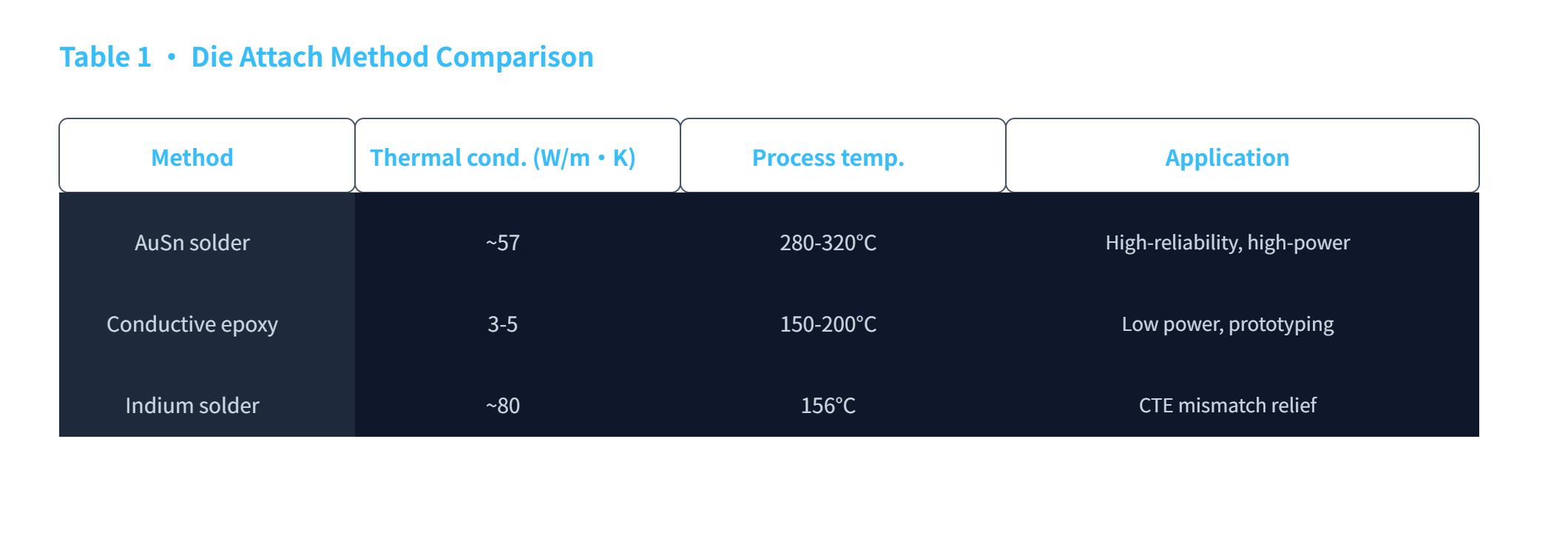
AuSn solder provides the best thermal conductivity and long-term reliability, preferred for high-power devices
Heat sink materials: copper-diamond (300-600 W/m·K), CuW (180-220), AlN (140-200). TO-CAN uses CuW or AlN, butterfly uses AlN or SiC. Key parameters: solder thickness 10-25 μm, void ratio<5%, placement accuracy ±10 μm.
3. Wire Bonding
Wire bonding connects chip electrodes to package pins.
Thermocompression: 250-350°C, high strength but may damage chip.
Ultrasonic: room temperature, no thermal damage, but lower strength for Al-Al bonds.
Thermosonic: 100-200°C + ultrasonic, excellent quality and wide process window. This is the mainstream method.
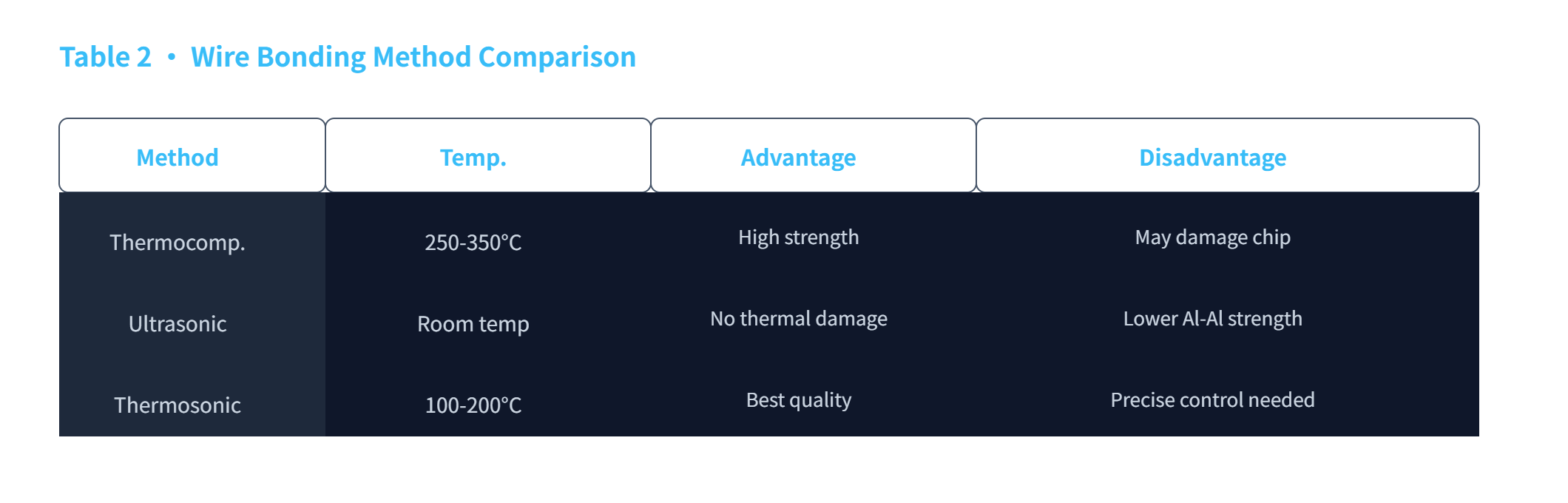
Thermosonic Au-Au bonding is the mainstream choice, balancing strength and process control
4. Fiber Coupling
Butt coupling: efficiency 30-50%, simple but alignment tolerance<1 μm.
Lens coupling: 50-80%, large working distance, better tolerance, higher cost.
Tapered fiber: 60-85%, no additional lens, but high fiber processing cost.
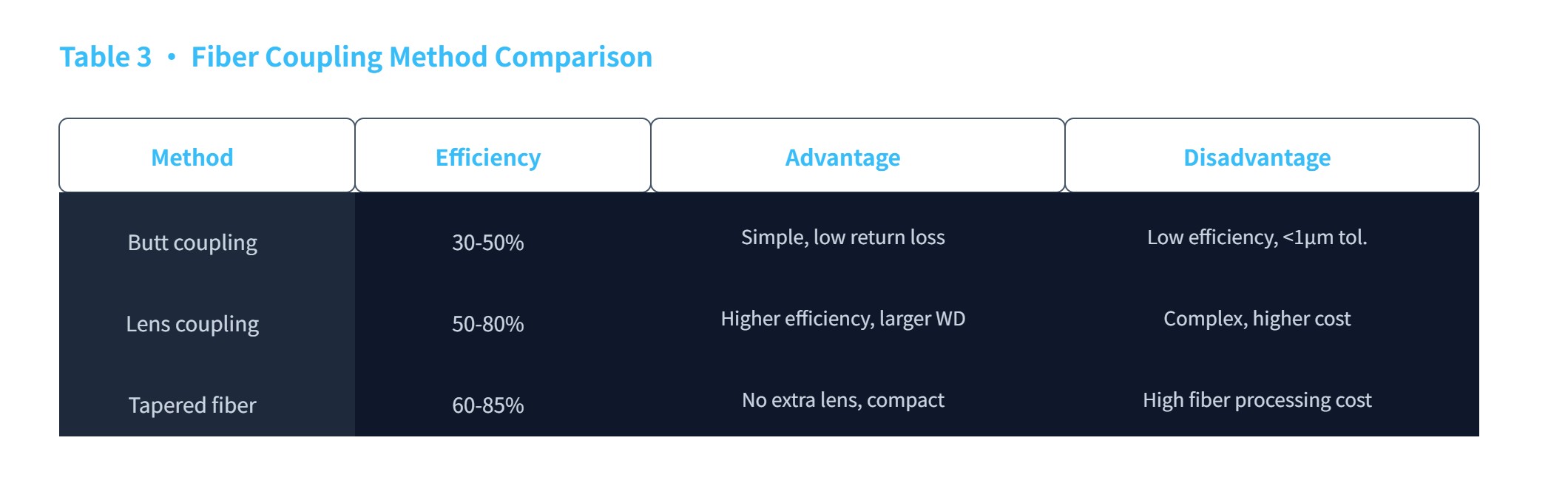
Lens coupling offers the best balance between efficiency and cost for high-power/high-performance devices
Alignment precision: X/Y 0.1-0.5 μm for single-mode fiber, Z 1-5 μm. 6-axis precision stages and automatic search algorithms are used. Fixation: laser welding (high strength) or UV epoxy (fast).
5. Main Package Types
TO-CAN: simple, low cost, hermetic. Thermal resistance 30-80°C/W, suitable for low-to-medium power.
Butterfly (BTF): flat metal case, 14/16-pin, integrates TEC, MPD, lens and isolator. Thermal resistance<20°C/W, supports high-speed modulation.
COB (Chip on Board): bare die mounted directly on PCB/ceramic substrate, no housing, ultra-thin, low inductance, but poor environmental tolerance. Suitable for multi-chip modules, optical transceivers, consumer electronics.
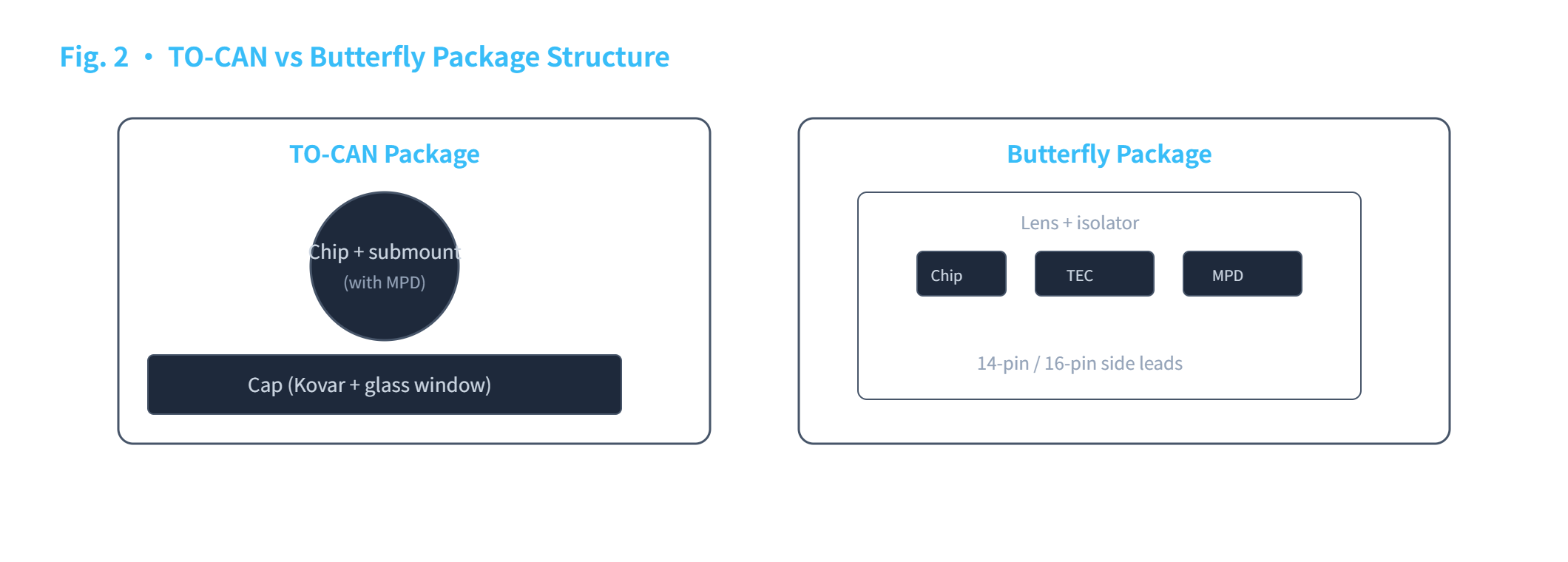
TO-CAN is simple and low-cost; butterfly integrates TEC and isolator for high-performance applications
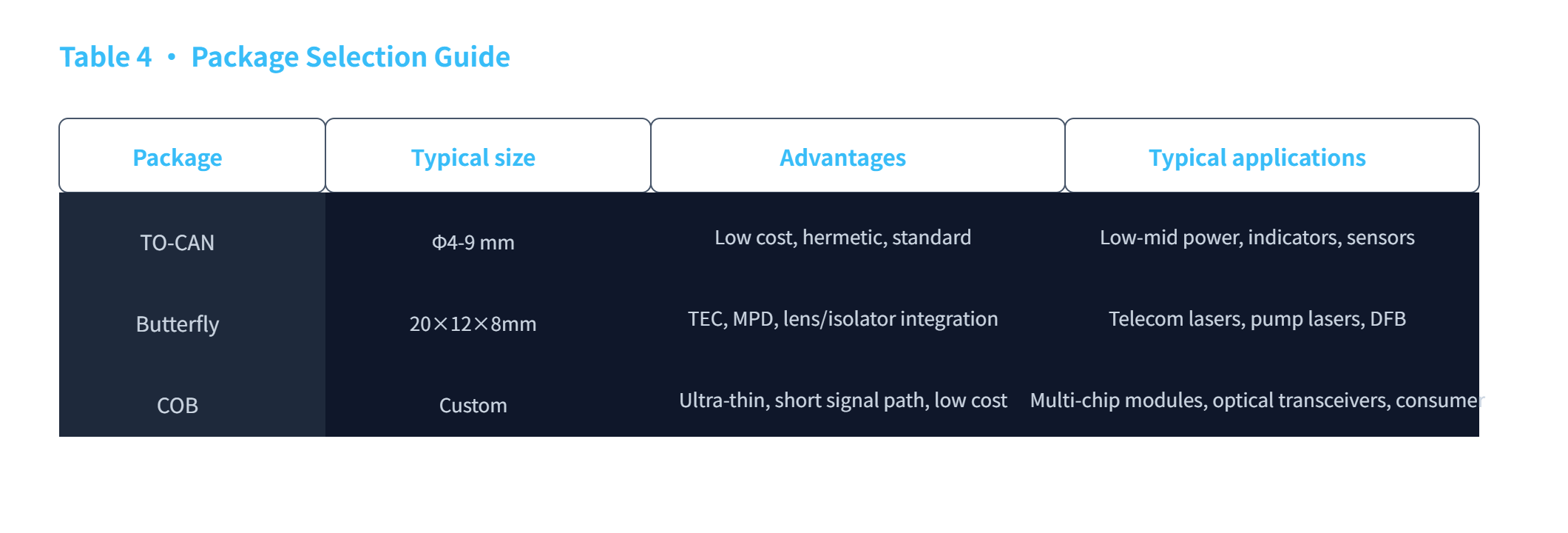
Choose package type based on application: cost-sensitive → TO-CAN; performance-driven → butterfly; space-constrained → COB
6. Packaging Testing & Quality Control
Optical performance: P-I-V curve, Ith, slope efficiency, center wavelength, spectral width, coupling efficiency, MPD responsivity, TEC performance.
Mechanical tests: fiber pull 1-2 kg, torque 0.5 Nm, vibration 20G, shock 500G.
Environmental tests: high-temp storage 85°C/1000h, temp cycle -40↔85°C/500 cycles, damp heat 85°C/85%RH/1000h, hermeticity leak rate<1×10⁻⁸ atm·cc/s.
Burn-in: at rated max temperature and current for 48-168 hours to eliminate early failures.
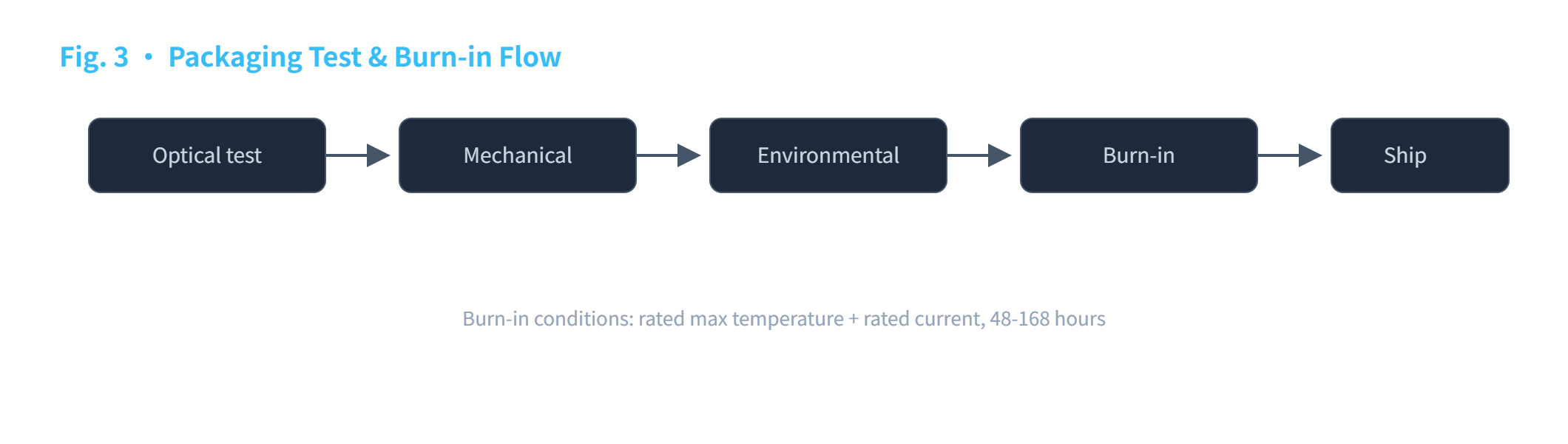
Complete test & burn-in flow ensures every device meets reliability targets before shipment
7. Emerging Trends
Silicon photonics integration: III-V laser flip-chip or wafer bonding onto silicon photonic chips for chip-level optical interconnects.
Co-packaged optics (CPO): optical modules placed next to switching ASICs to shorten electrical paths and reduce power.
Automated packaging: machine vision + AI algorithms to reduce fiber alignment time from 3-10 minutes to<1 minute.
Multi-chip packaging: 4/8 channel parallel lasers to meet future high-bandwidth demands.
We will continue to invest in packaging R&D: automated alignment systems, silicon-photonics-ready packages, thermal optimization, and custom solutions.
8. Conclusion
Semiconductor laser packaging is the critical bridge from bare die to commercial product. This article has introduced the three core processes (die attach, wire bonding, fiber coupling) and three mainstream package types (TO-CAN, butterfly, COB). Every detail – solder thickness, bond strength, alignment accuracy, heat sink material, burn-in conditions – directly affects final device performance and reliability.
We are committed to delivering high-quality, high-reliability packaged laser products for applications ranging from research to industrial and telecom.