
No Best Detector, Only the Most Suitable — Balancing Speed, Sensitivity and System Architecture
Core insight: PIN and APD are not substitutes; they are optimal choices for different scenarios. PIN pursues speed and linearity, APD pursues the ultimate sensitivity. Choosing the right detector is the first and most critical step in optical communication system design.
In optical communication systems, the transmitter converts electrical signals into optical signals, while the receiver must convert optical signals back to electrical signals — a critical conversion performed by photodetectors. The photodetector is the core of the optical receiver; its performance directly determines system sensitivity and transmission distance. Unlike CMOS sensors in phone cameras, communication photodetectors must operate at very low optical power (-20 to -30 dBm, i.e., micro-watt to nano-watt levels) and achieve high speed (10 Gbps to 400 Gbps). The two most common types are PIN photodiodes and APD avalanche photodiodes. This article provides an in-depth analysis of their principles, performance differences and selection strategies.
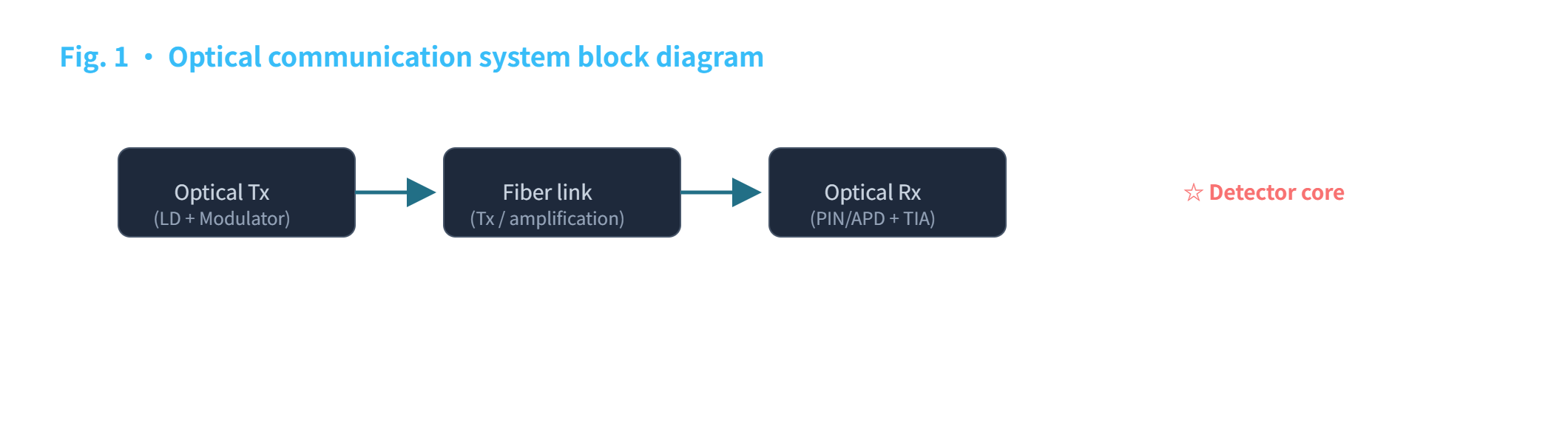
The photodetector at the receiver front-end performs the optical-to-electrical conversion, determining system sensitivity
1. PIN Photodiode: Simplicity and High Speed
1.1 Operating principle
The PIN photodiode consists of a P-type layer, an intrinsic (I) absorption layer and an N-type layer. Under reverse bias, the I-layer forms a wide depletion region. Photons absorbed in the I-layer generate electron-hole pairs which drift rapidly under the electric field, producing photocurrent. The wide depletion region increases absorption efficiency while reducing carrier transit time, balancing responsivity and speed.
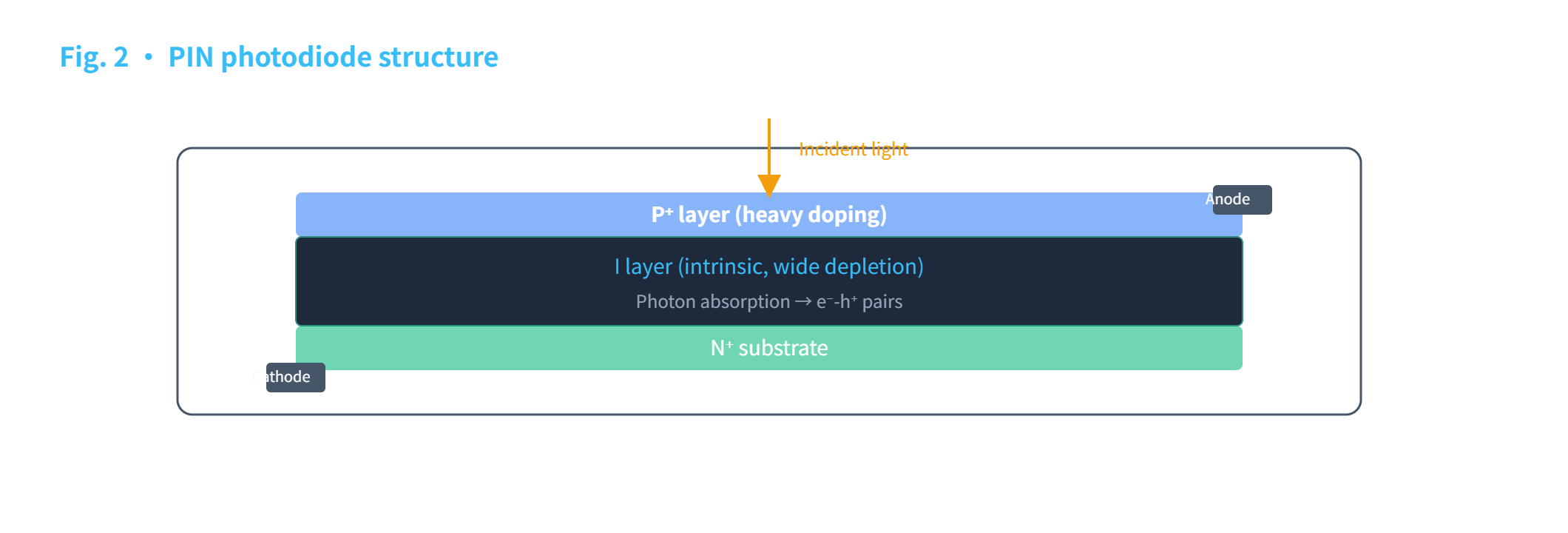
PIN structure adds an intrinsic layer to widen the depletion region, improving quantum efficiency while maintaining high speed
1.2 Key parameters, advantages and limitations
PIN detectors feature fast response (up to 40+ GHz), excellent linearity, low noise and low cost, but they have no internal gain and limited sensitivity (approx. -20 dBm @ 10 Gbps). They are especially suitable for short-reach high-speed links such as data center interconnects.
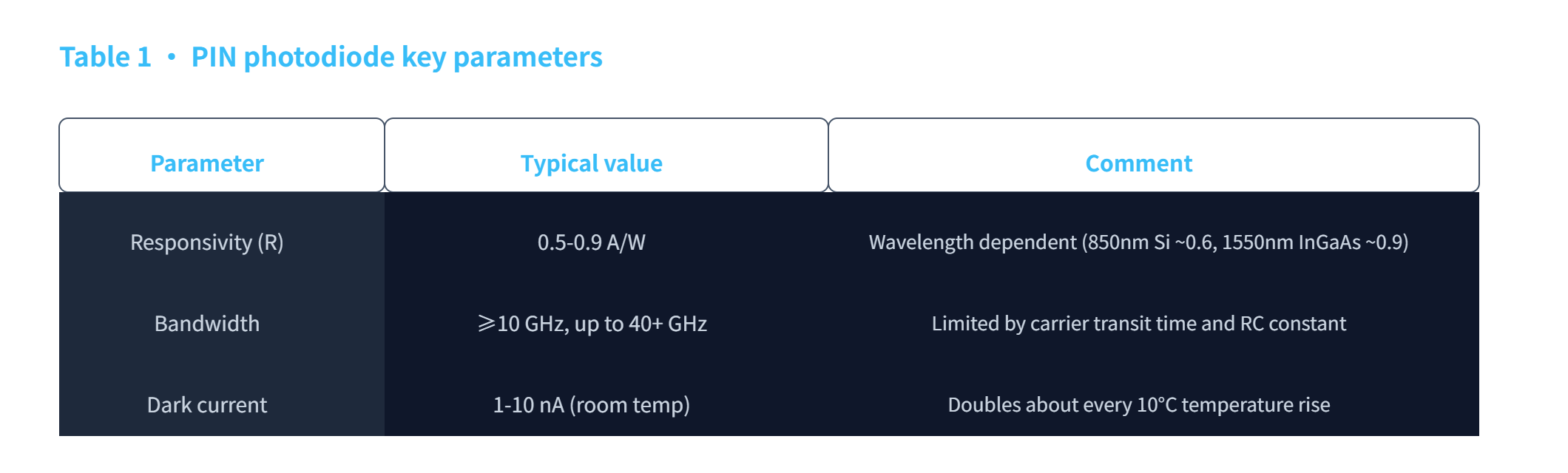
PIN detector parameters; the core advantages are high speed and linearity
2. APD Avalanche Photodiode: Pursuit of Ultimate Sensitivity
2.1 Avalanche multiplication effect
APD adds a high-electric-field multiplication region to the PIN structure. Photogenerated carriers gain enough energy in the strong field (>10⁵ V/cm) to impact-ionize and generate new electron-hole pairs — avalanche multiplication. The multiplication factor M typically ranges from 10 to 30, providing 8-10 dB sensitivity improvement over PIN, which extends the transmission distance by 40-50 km.
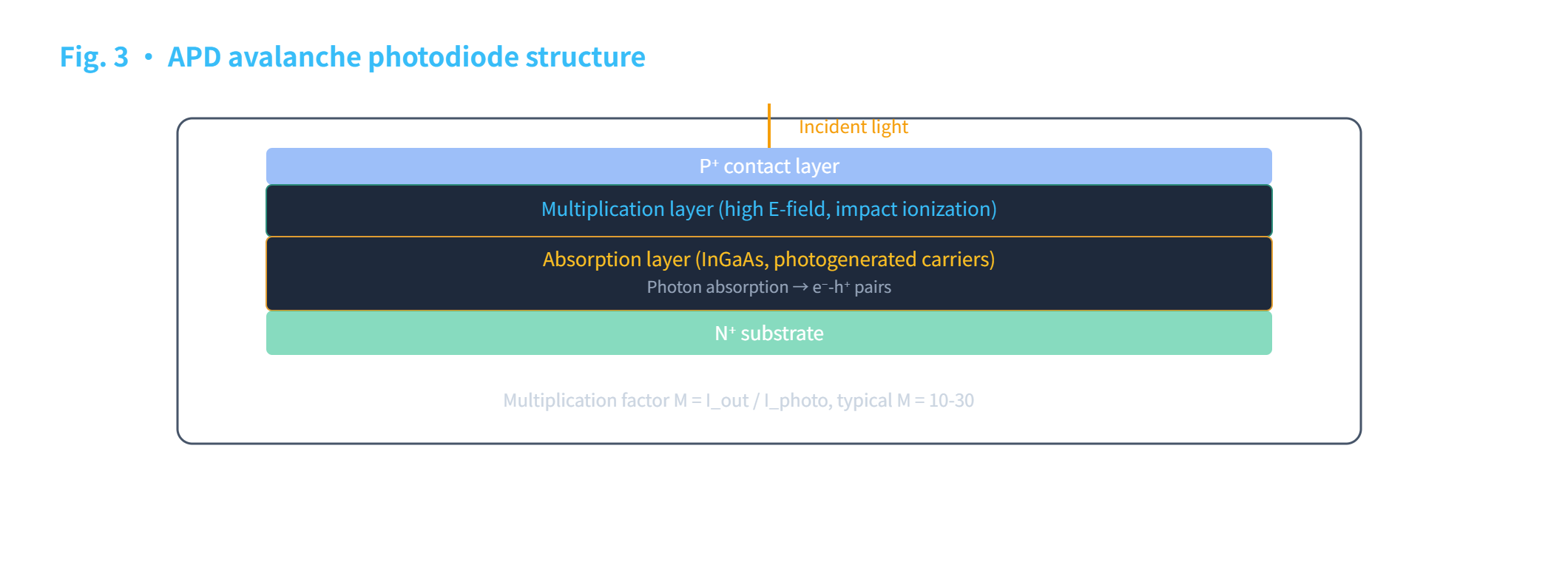
APD uses a multiplication region to provide internal gain, significantly enhancing weak-light detection sensitivity
2.2 Excess noise and optimum gain
Avalanche multiplication introduces an excess noise factor F = k_eff × M + (1 - k_eff). For InGaAs/InP APD, k_eff is about 0.3-0.5, F is about 3-6 (at M=10). The optimum multiplication factor M_opt is typically in the range 10-20; higher values degrade sensitivity due to excess noise domination.
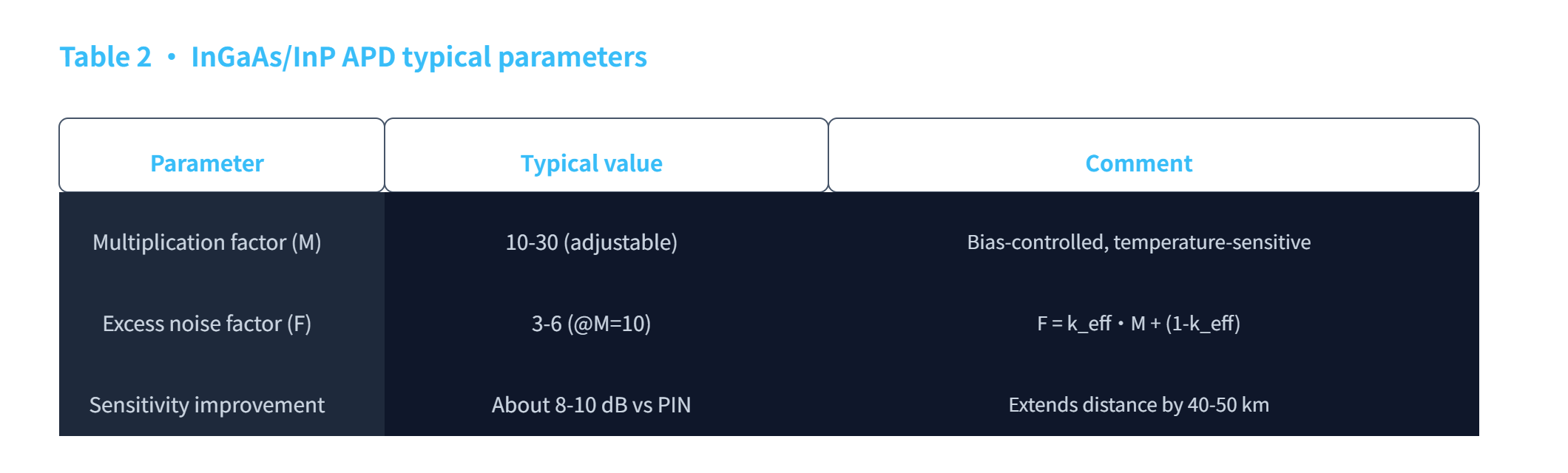
APD trades multiplication noise for high sensitivity; optimum gain balances signal and noise
3. PIN vs APD: How to Choose
The choice between PIN and APD depends on transmission distance, data rate and cost constraints. For short-reach high-speed links (data centers, 5G front-haul) use PIN. For long-haul high-sensitivity (metro networks, PON) use APD. For coherent detection (100G+ long-haul) the local oscillator provides gain, making PIN the choice again. APD requires high bias voltage (30-60V) and temperature compensation, increasing system complexity.
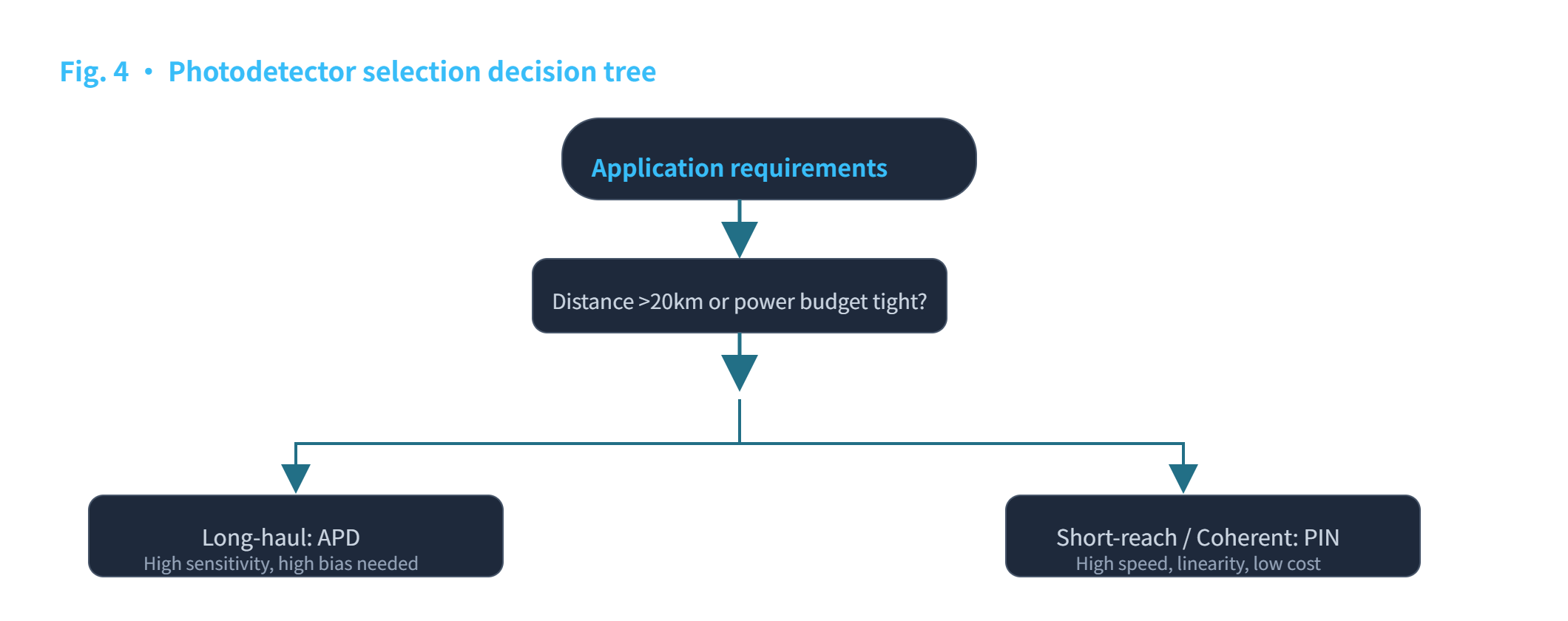
Rule of thumb: short-reach → PIN, long-haul → APD, coherent → PIN, single-photon → SPAD
4. Emerging Detector Technologies: Silicon Photonics and Single-Photon Era
4.1 Ge-on-Si detectors
Germanium absorption layers integrated on silicon photonics platforms enable 1310/1550nm response. Bandwidth can reach 40+ GHz with dark current 10-100 nA, becoming the standard for silicon-photonics transceivers.
4.2 SPAD single-photon detectors
SPADs operate in Geiger mode (bias above breakdown voltage); a single photon triggers a full avalanche. Single-photon sensitivity makes them the core detector for LiDAR and quantum communication, enabling >200 m ranging in automotive LiDAR.
4.3 SiPM silicon photomultipliers
SiPMs consist of thousands of micro-SPAD cells in parallel, combining single-photon sensitivity with linear response. They are rapidly expanding in LiDAR, bioluminescence detection and high-energy physics.
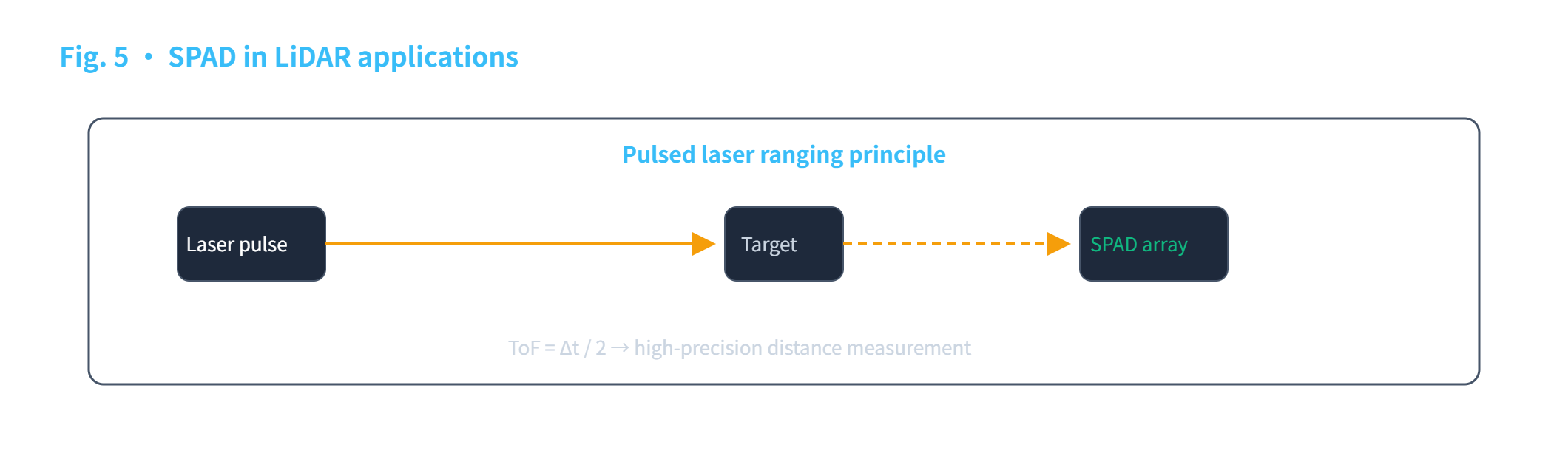
SPAD single-photon sensitivity combined with time-correlated single-photon counting (TCSPC) enables long-range high-precision 3D ranging
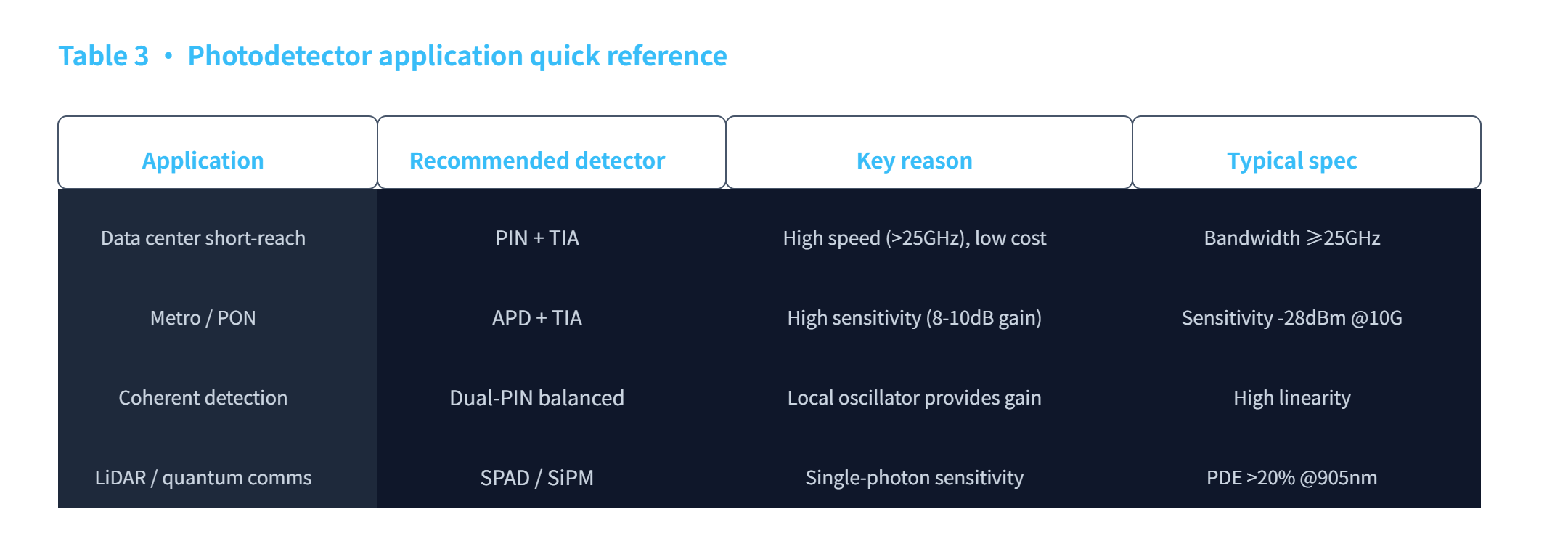
Detector selection recommendations for different scenarios, balancing performance and cost
5. Conclusion: No Best Detector, Only the Most Suitable
PIN and APD are not substitutes; they are optimal choices for different scenarios. PIN pursues speed and linearity, APD pursues ultimate sensitivity. In short-reach high-speed data center links, PIN dominates; in long-haul PON high-sensitivity applications, APD is indispensable; in coherent detection, PIN returns to the mainstream. With silicon photonics integration, Ge-on-Si PIN detectors are becoming the standard for next-generation optical modules; meanwhile, SPAD/SiPM are rising in LiDAR and quantum communication, opening a new chapter in detector technology.
✦ Choosing the right detector is the first and most critical step in optical communication system design.